
September 15, 2026
Algorithms do not possess politics, ideology or ambition. But the systems they power can shape what we see, what we never encounter and how we behave. Behind that extraordinary capability lies a more consequential question: Who is giving the instructions?
By the InnerKwest Editorial Desk
Most people encounter an algorithm before they finish breakfast.
Unlock the phone. Open a social platform. Scroll through a feed. Check a search result. Watch a video. Read a recommendation. Tap a notification.
It feels like choice.
And much of it is.
But before we choose what to click, watch, read, buy, ignore or share, another process has already occurred. Something determined what would appear on the screen, where it would appear, how often it might appear, who else might see it and what would remain somewhere beyond our immediate field of vision.
That something is increasingly described simply as the algorithm.
The phrase has become so common that it almost gives the technology a personality. The algorithm likes controversy. The algorithm hates certain subjects. The algorithm decided to suppress a post. The algorithm wants us addicted.
But algorithms do not have political beliefs. They do not possess ideologies, commercial ambitions, grudges or corporate loyalties. They do not wake up wanting engagement.
They execute.
And that distinction changes the question entirely.
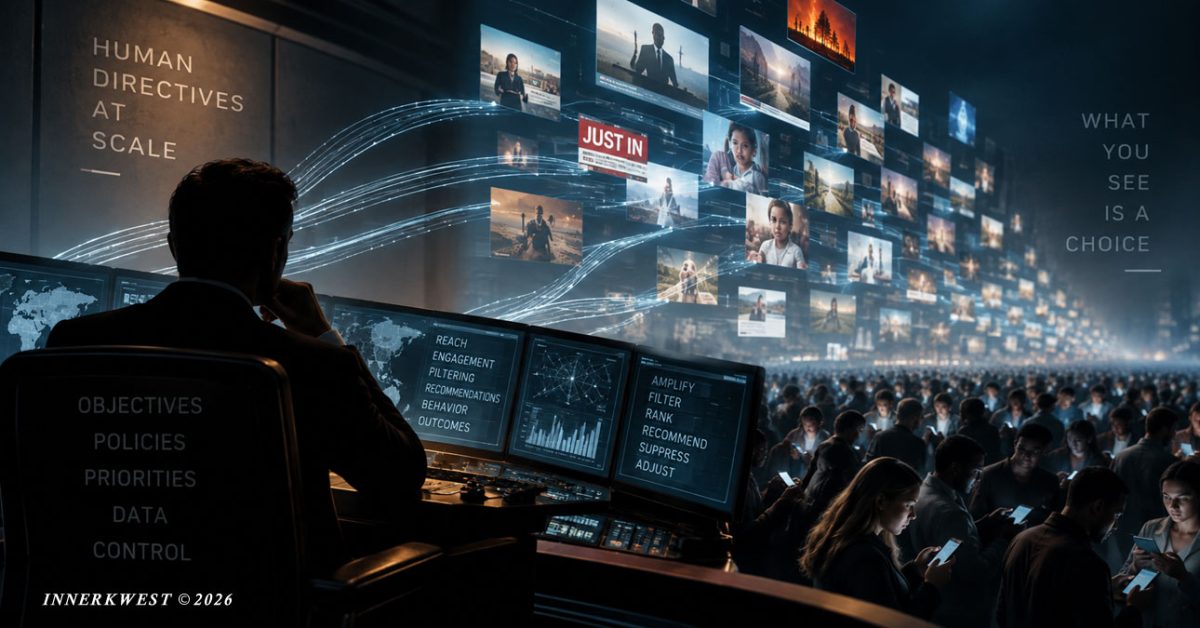
The real power of algorithmic technology is its ability to execute human objectives at extraordinary scale. The algorithm is not the boss. It is the instrument.
Behind the Screen
Modern digital platforms could hardly function without algorithms.
Billions of pieces of content compete for attention. Fraud must be detected. Spam must be filtered. Bot networks must be identified. Dangerous material must be reviewed. Search results must be ranked. Recommendations must somehow be selected from inventories far larger than any human being could examine.
This is algorithmic control working for us.
A platform that presented everything chronologically, indiscriminately and without classification would quickly become difficult to navigate. Algorithms bring order to an otherwise overwhelming information environment.
But the same capability that can identify spam can classify other information. The same architecture that recommends something can decline to recommend something else. The same system capable of identifying the people most likely to appreciate a piece of content can identify the people most susceptible to another kind of message.
The technology has not changed.
The objective has.
And objectives lead us back to people.
Management establishes priorities. Product teams design systems around them. Engineers translate objectives into software. Policy departments establish classifications and rules. Administrators can establish permissions, restrictions and exceptions.
Those instructions can become thresholds, weights, rankings, eligibility requirements, recommendation criteria, filters and optimization targets.
Once implemented, software supplies something human administrators could never achieve manually:
scale.
One directive can potentially influence the digital environments experienced by millions of people.
Choice Happens Downstream From Exposure
Consider a hypothetical.
A celebrity such as Oprah Winfrey posts identical material to two enormous social platforms. On one, it receives 30 million views. On another, 4,000.
What happened?
We cannot conclude from those numbers alone that the second platform suppressed the content. Different audiences behave differently. Platforms have different user populations, recommendation systems and patterns of engagement.
But neither can we automatically conclude that 30 million people on one platform wanted the content while only 4,000 on the other did.
There is a missing variable:
How many people were given the opportunity to encounter it?
Before someone watches a video, the video must somehow reach that person.
This is where distribution becomes power.
An algorithm can amplify. It can recommend. It can rank. It can target. It can repeatedly introduce material into someone’s environment.
But control does not require deletion.
Content can remain perfectly intact on a server, accessible through a direct link and perhaps discoverable through a deliberate search, while becoming nearly invisible to ordinary platform discovery.
It doesn’t necessarily disappear.
It can simply be filtered away.
That distinction matters because the modern information environment isn’t controlled solely by deciding what people are permitted to publish. Increasingly, it is shaped by deciding what other people are likely to encounter.
Choice happens downstream from exposure.
When Optimization Becomes Behavioral Management
The system becomes considerably more powerful when it begins learning from us.
Pause over a video.
Swipe away from another.
Click a headline.
Watch something twice.
Abandon a video after seven seconds.
Return tomorrow.
Follow an account.
Argue with another.
Each interaction can become another piece of information about what captures attention and what does not.
That information can make a service remarkably useful. A music platform learns what we enjoy. A fraud system learns what suspicious activity looks like. A search engine becomes better at determining relevance.
But prediction can also become management.
If a system can determine what is likely to produce a behavioral response, it can increasingly construct an environment designed to produce that response.
Recent litigation involving Meta provides an unusually visible window into that distinction. Litigation described in court accused Meta of deliberately incorporating features into Facebook and Instagram that exploited compulsive behaviors among young users, including endless scrolling, social validation, continual rewards and fear of missing out. Those remain allegations, and Meta has denied wrongdoing.
But testimony described in the proceedings went deeper. A former data scientist reportedly testified that teams had been prevented from making certain safety settings defaults for teenagers because executives worried about reducing time spent on the platforms.
That distinction is central.
The software did not independently decide that time-on-platform mattered.
A human objective came first.
Change the Directive, Change the Environment
Now observe what happens when the directive changes.
The Meta settlement described in the proceedings includes a default two-hour daily limit for minors across Facebook and Instagram, overnight restrictions, school-hour notification controls and other protections, along with independent auditing. Meta admits no wrongdoing.
Look beyond the litigation for a moment and examine the mechanics.
A platform can permit notifications at one hour and restrict them at another.
It can establish one default today and another tomorrow.
It can determine which accounts qualify for particular experiences.
It can change what its software is instructed to do.
That is implementation.
Human directive → system objective → algorithmic execution → behavioral consequence.
Algorithms can subsequently learn and adjust within those systems, particularly when machine learning is involved. But adaptive execution should not be confused with independent purpose.
Humans still determine what the system is supposed to optimize, which information it may use, what measurements constitute success, what constraints apply and whether the system remains deployed.
Autonomy of execution is not autonomy of purpose.
The Uncomfortable Side of Control
None of this establishes that every platform is secretly manipulating political speech, competitors or ideological opponents.
Capability is not evidence of a particular act.
That distinction must remain firm.
But once the capability is understood, another question becomes unavoidable.
What happens when management’s objective is subjective?
Political preference.
Ideology.
Competitive advantage.
Commercial relationships.
Institutional interests.
Reputation.
The technology does not understand the moral difference between filtering a bot network and filtering something because someone with sufficient authority doesn’t want it widely distributed.
That distinction exists in governance, not software.
Bias does not even have to be explicitly programmed as bias. It can enter through definitions.
Who determines what is “authoritative”?
What qualifies as “borderline”?
What is considered “low quality”?
Which sources are “trusted”?
What becomes eligible for recommendation?
What should be demoted?
Once those human judgments become classifications, algorithms can administer them repeatedly and at enormous scale.
The danger, therefore, isn’t necessarily a sinister executive sitting behind a screen pushing a button against individual users.
The far greater power is the ability to establish a rule and have machines execute it everywhere.
Who Audits the Control Room?
The obvious answer is transparency and independent auditing.
That is necessary.
It is not sufficient.
An audit is only as revealing as its scope, methodology and access.
Which version of the system was examined? Which users? Which time period? What data were supplied? Can the auditor independently validate those data? Are administrative interventions logged? Can historical configurations be reconstructed? Can an outside auditor determine what someone actually experienced six months earlier?
The Meta settlement’s independent-auditing provision demonstrates that outside examination can become part of algorithmic accountability.
But there remains a fundamental asymmetry.
The public can observe outcomes.
The platform possesses the mechanism.
That makes transparency more complicated than simply demanding that a company say its algorithms are fair.
The question is whether outsiders can meaningfully verify it.

The Power Behind the Algorithm
Algorithms are not inherently enemies of society. We depend upon them, and increasingly we will depend upon more sophisticated versions of them.
They can protect children, expose fraud, organize knowledge, detect threats, improve transportation, personalize medicine, manage infrastructure and help navigate quantities of information no human mind could process alone.
The same technological power can also be used to maximize engagement, influence behavior, determine visibility, shape information environments or execute objectives the person experiencing them may never know exist.
That is the good, the bad and the ugly of algorithmic behavioral control.
But responsibility should not be misplaced.
The machine does not possess politics.
The machine does not possess ideology.
The machine does not covet market share.
People do.
Behind every algorithmic objective remains a human decision about what the system should accomplish.
So perhaps the most important question of the algorithmic age isn’t whether algorithms are becoming too powerful.
It is more fundamental than that.
Who controls them?
Because the algorithm may execute the decision.
But all roads lead back to human directives.
At InnerKwest.com, we are committed to delivering impactful journalism, deep insights, and fearless social commentary. Your cryptocurrency contributions help us execute with excellence, ensuring we remain independent and continue to amplify voices that matter.
To help sustain our work and editorial independence, we would appreciate your support of any amount of the tokens listed below. Support independent journalism:
BTC: 3NM7AAdxxaJ7jUhZ2nyfgcheWkrquvCzRm
SOL: HxeMhsyDvdv9dqEoBPpFtR46iVfbjrAicBDDjtEvJp7n
ETH: 0x3ab8bdce82439a73ca808a160ef94623275b5c0a
XRP: rLHzPsX6oXkzU2qL12kHCH8G8cnZv1rBJh TAG – 1068637374
SUI – 0xb21b61330caaa90dedc68b866c48abbf5c61b84644c45beea6a424b54f162d0c
and through our Support Page.
InnerKwest maintains a revelatory and redemptive discipline, relentless in advancing parity across every category of the human experience.
© 2026 InnerKwest®. All Rights Reserved | Haki zote zimehifadhiwa | 版权所有. InnerKwest® is a registered trademark of Inputit™ Platforms Inc. Global. No part of this publication may be reproduced, distributed, or transmitted in any form or by any means without prior written permission. Unauthorized use is strictly prohibited. Thank you for standing with us in pursuit of truth and progress!