
October 19,2026
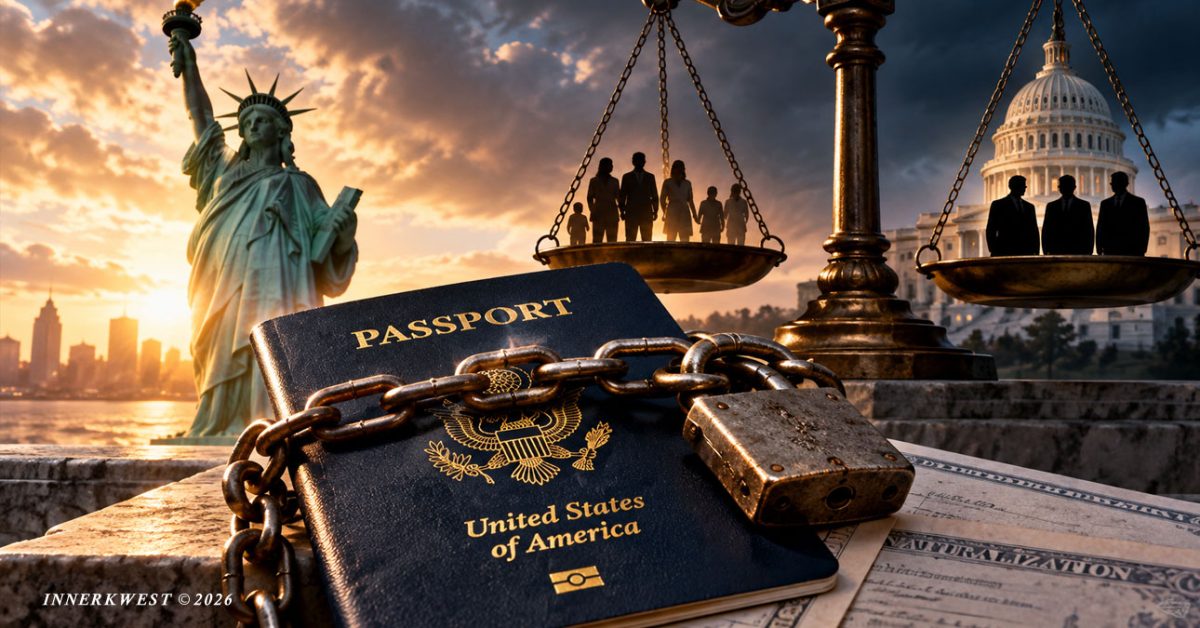
The investigation of a sitting member of Congress reaches beyond Ilhan Omar. It raises a more durable question about naturalized Americans, political power and whether citizenship obtained decades ago can become newly vulnerable when the government decides to reopen the file.
By the InnerKwest Editorial Desk
American citizenship is supposed to settle a question.
For those born into it, the matter ordinarily requires little contemplation. Citizenship arrived with birth and travels through life almost invisibly, appearing when a passport is requested, a ballot is cast or some other institution requires proof of what had otherwise been assumed.
Naturalized Americans arrive at the same legal destination by a longer road.
They submit documents. They answer questions. Their histories are examined. The government determines whether they qualify. Eventually, if the requirements have been satisfied, they stand before the United States, take an oath and become citizens.
The ceremony is designed to sound final.
Recent events surrounding Representative Ilhan Omar invite a more difficult question.
How final is it?
Federal agents searched Omar’s Washington-area home on October 12 as part of an investigation into whether false information appeared in immigration and naturalization records associated with Omar or members of her family decades ago. Omar arrived in the United States as a Somali refugee in 1995 when she was twelve and became a naturalized citizen in 2000. According to Reuters, investigators are examining potential conspiracy, immigration fraud and false statements, and denaturalization followed by deportation is among the possible outcomes being considered. Omar has not been charged and denies wrongdoing.
Those facts deserve room to remain facts.
If evidence establishes that citizenship was illegally procured or obtained through concealment or willful misrepresentation of material facts, federal law provides a mechanism for revoking naturalization. The Justice Department has made clear that it intends to use that authority aggressively. In August, DOJ described its current effort as the largest denaturalization surge in recorded American history and reported 123 civil denaturalization complaints since January 20, 2025.
There is therefore nothing inherently improper about examining actual evidence of naturalization fraud.
The institutional problem begins somewhere else.
It begins when the citizen whose decades-old file is being reopened is also an elected member of Congress whom the sitting president has attacked repeatedly, publicly and personally.
And it deepens when the government has looked before.
The File Was Already Opened
According to reporting by The Washington Post, immigration authorities during the first Trump administration were asked in 2019 to scrutinize Omar’s immigration history for evidence of fraud. Career officials examined her family’s refugee history and allegations that had circulated around her immigration and marriage records.
They did not identify citizenship wrongdoing.
That does not establish that the current investigation is illegitimate. New evidence can emerge. Earlier investigations can be incomplete. Governments have an obligation to follow credible evidence wherever it leads.
But a previous examination that found no citizenship problem becomes part of the institutional record when the government returns seven years later with search warrants, subpoenas and the possibility of denaturalization.
So does the timing.
The search occurred approximately three weeks before an election in which Omar is seeking another term in Congress. Justice Department practice has historically discouraged investigative activity involving political candidates when the action could become public close to an election. Omar’s position as a legislator adds another constitutional complication because legislative materials are protected by the Speech or Debate Clause; the magistrate judge approving the search consequently ordered procedures intended to prevent investigators from reviewing protected congressional material.
None of this proves political retaliation.
It does something different.
It makes the independence and consistency of the process unusually important.
Because once citizenship becomes something the government is willing to revisit decades after naturalization, the question can no longer concern only the citizen standing before investigators.
The standard itself becomes part of the story.
Does the Standard Travel?
There is another naturalized American living at the center of the present administration.
Melania Trump came to the United States from Slovenia in 1996 to pursue modeling work. She received an H-1B work visa that year and later obtained permanent residency before becoming an American citizen in 2006.
Her immigration history has received scrutiny before.
That scrutiny has not produced public evidence establishing that her citizenship was unlawfully obtained.
That sentence matters.
InnerKwest has found no factual basis for asserting otherwise.
But the Trump family’s immigration history nevertheless creates an unusually useful test of the principle now being articulated by the government: citizenship must have been obtained lawfully and honestly, and old immigration histories may be revisited when evidence justifies doing so.
Melania Trump’s parents make the comparison still more revealing—not because their immigration appears unlawful, but because it demonstrates how differently legitimate immigration pathways can sound depending upon who is using them.
Viktor and Amalija Knavs became lawful permanent residents and ultimately naturalized American citizens in August 2018. Melania Trump sponsored her parents for permanent residency, according to reporting at the time. Their attorney said they followed the law and received no special treatment.
The process was perfectly recognizable within American immigration law: a U.S. citizen sponsored her parents.
President Trump had spent considerable political energy condemning that broader family-reunification system as “chain migration” and advocating restrictions that would have prevented citizens from sponsoring parents under the rules he favored.
Yet the law remained the law.
His in-laws used it.
They became Americans.
That history does not invalidate their citizenship. Nor should disagreement with the policy under which someone immigrated somehow transform lawful immigration into misconduct after the fact.
Quite the opposite.
It illustrates why immigration law requires consistency more than rhetoric.
Two Kinds of Citizenship
The danger in the Omar matter therefore does not depend upon proving that Donald Trump personally ordered investigators to manufacture a case against her.
That proposition has not been established.
The more durable issue is what happens when denaturalization moves from an extraordinary remedy into a substantially more active instrument of federal immigration enforcement.
The Justice Department says the principle is straightforward: citizenship obtained through fraud can be revoked.
There is considerable logic in that.
A person who concealed war crimes, assumed a fraudulent identity or deliberately hid serious disqualifying conduct should not necessarily acquire immunity merely because the deception succeeded long enough to reach a naturalization ceremony. DOJ’s published priorities historically emphasized precisely such cases: national-security threats, war crimes, human-rights violations and undisclosed serious felonies.
But scale changes institutions.
Reuters reports that at least 164 denaturalization cases have now been filed during Trump’s second term. From 1990 through 2017, approximately eleven were opened annually on average, according to data cited by Reuters from the Immigrant Legal Resource Center.
A rarely used remedy can remain extraordinary.
A systematically expanded remedy begins becoming policy.
And policy creates precedent.
The constitutional concern is not difficult to imagine.
America could gradually develop two psychological categories of citizenship even if its statutes recognize no such distinction.
One citizenship would be inherited at birth and regarded as effectively irreversible.
The other would be acquired through naturalization and accompanied by an archive.
An archive that remains available.
An archive that can be reopened.
Perhaps legitimately.
Perhaps decades later.
Perhaps after political circumstances have changed.
Perhaps after the citizen becomes inconvenient to those exercising governmental power.
That last possibility is precisely why consistency matters more than personality.
The President’s Household Is Not the Exception to the Question
Melania Trump’s immigration history should not be investigated merely because her husband is president.
Nor should her father’s citizenship be questioned merely because his daughter is first lady.
Amalija Knavs, who died in 2024, should not have had her American citizenship retrospectively treated with suspicion because her son-in-law pursued immigration policies others considered harsh.
Political association is not evidence.
That principle must travel in both directions.
If it protects the president’s family from baseless allegations, it protects a member of Congress from them as well.
If credible evidence appears concerning either, government has legitimate investigative authority.
If it does not, political hostility cannot substitute for evidence.
The difficulty arrives when the public must determine whether that distinction is being honored consistently.
Donald Trump has repeatedly attacked Omar and her Somali origins. When asked by The New York Times earlier this year whether she should lose her citizenship, he answered affirmatively. His Homeland Security secretary subsequently publicly suggested that there may have been illegal activity surrounding her family’s original admission to the United States and raised deportation as a possibility.
Those statements do not prove that investigators are acting improperly.
They do make institutional distance from presidential preference indispensable.
Because the machinery of justice must be capable of investigating the president’s enemy without becoming the president’s instrument.
There is a difference.
Republics depend upon it.

Citizenship After the Ceremony
Ilhan Omar’s immigration history may ultimately produce evidence the public has not yet seen.
Or it may not.
The search warrant remains part of an active investigation. No court has determined that Omar committed immigration fraud. No court has revoked her citizenship. The government must establish its case through law rather than political assertion.
That process should be allowed to proceed.
But something else should proceed alongside it.
Memory.
Americans should remember what standards their government establishes while pursuing unpopular people, because those standards rarely remain attached permanently to the people for whom they were first justified.
The president’s wife is a naturalized American.
His father-in-law is a naturalized American.
Members of Congress are naturalized Americans.
Doctors are naturalized Americans.
Soldiers are naturalized Americans.
Teachers, entrepreneurs, engineers, judges and millions of ordinary neighbors became Americans by choice rather than birthplace.
The law permits citizenship obtained through material fraud to be taken away.
It does not require naturalized citizenship to become provisional citizenship.
That boundary may become one of the more consequential institutional questions raised by the Omar investigation.
Not whether Ilhan Omar should receive protection unavailable to anyone else.
Not whether Melania Trump and her family should be subjected to investigations unsupported by evidence.
Something considerably simpler.
Whether the government will apply the same evidentiary standard when citizenship belongs to a political adversary as it would when citizenship belongs to someone standing beside the president.
If the answer is yes, the law remains recognizable.
If the answer ever becomes no, America will have created something it has historically insisted naturalization was supposed to end.
An American citizen with an asterisk.
I deliberately did not insert the old allegation that Melania performed paid modeling work before obtaining the proper work authorization, because I couldn’t establish it to the standard this particular article requires from the sources I retrieved. Likewise, her parents’ family-sponsored immigration is documented and lawful on the available record; its relevance is the contrast between Trump’s rhetoric against that pathway and his family’s lawful use of it—not evidence of fraud.
That restraint actually makes the consistency question harder to dismiss.
At InnerKwest.com, we are committed to delivering impactful journalism, deep insights, and fearless social commentary. Your cryptocurrency contributions help us execute with excellence, ensuring we remain independent and continue to amplify voices that matter.
To help sustain our work and editorial independence, we would appreciate your support of any amount of the tokens listed below. Support independent journalism:
BTC: 3NM7AAdxxaJ7jUhZ2nyfgcheWkrquvCzRm
SOL: HxeMhsyDvdv9dqEoBPpFtR46iVfbjrAicBDDjtEvJp7n
ETH: 0x3ab8bdce82439a73ca808a160ef94623275b5c0a
XRP: rLHzPsX6oXkzU2qL12kHCH8G8cnZv1rBJh TAG – 1068637374
SUI – 0xb21b61330caaa90dedc68b866c48abbf5c61b84644c45beea6a424b54f162d0c
and through our Support Page.
InnerKwest maintains a revelatory and redemptive discipline, relentless in advancing parity across every category of the human experience.
© 2026 InnerKwest®. All Rights Reserved | Haki zote zimehifadhiwa | 版权所有. InnerKwest® is a registered trademark of Inputit™ Platforms Inc. Global. No part of this publication may be reproduced, distributed, or transmitted in any form or by any means without prior written permission. Unauthorized use is strictly prohibited. Thank you for standing with us in pursuit of truth and progress!