
May 20, 2026
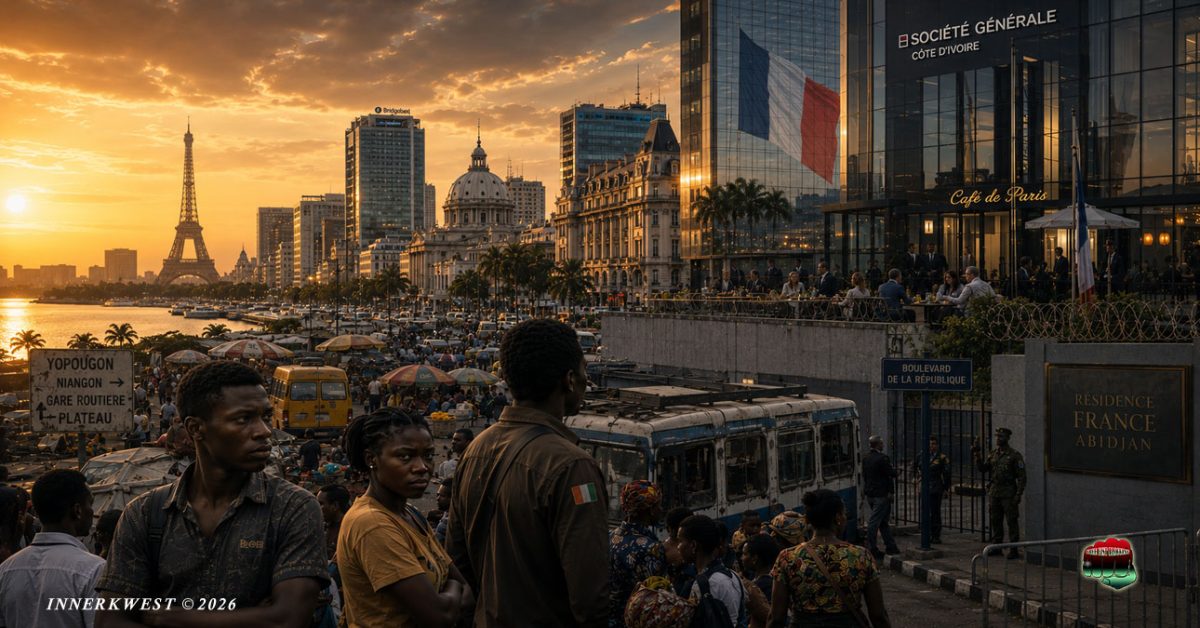
Côte d’Ivoire’s also known as Ivory Coast post-colonial evolution reflects a larger African debate: whether France’s continued strategic presence represents partnership, persistence, or the quiet language of unfinished influence.
By InnerKwest Intelligence Desk
France’s modern relationship with Africa is increasingly shaped not only by official diplomacy, military agreements, or economic partnerships, but by perception.
And in geopolitics, perception often communicates more powerfully than declarations themselves.
That reality sits beneath the growing debate surrounding Côte d’Ivoire and France’s continued strategic posture across Africa. Officially, Côte d’Ivoire gained independence from French colonial rule on August 7, 1960. Decades later, in February 2025, France formally handed over its final military base in the country — Port-Bouët — ending a six-decade permanent military presence on Ivorian soil.
Symbolically, the transfer mattered.
To France, it represented modernization of the relationship.
To many Africans, it represented delayed adjustment to political realities already changing across the continent.
Yet even after the withdrawal, roughly 80 French personnel reportedly remain in advisory, training, and intelligence capacities. France also remains one of Côte d’Ivoire’s largest trading partners, while broader institutional and financial relationships continue shaping the region.
This is where the deeper conversation begins.
Because modern African skepticism toward France is often less about a single military base or diplomatic agreement and more about the cumulative “non-verbal communication” of continued influence itself.
The Signals Beyond Diplomacy
In personal interaction, body language can communicate intentions words attempt to soften.
Geopolitics functions similarly.
Military positioning.
Currency systems.
Corporate access.
Security agreements.
Diplomatic leverage.
Resource relationships.
These become forms of strategic signaling.
And for many Africans, France’s continued involvement across parts of the continent communicates something psychologically larger than partnership alone:
that Paris still perceives Africa as strategically inseparable from French global power.
Whether intentional or not, the optics matter.
This is especially true for younger African populations increasingly shaped by:
- pan-African political consciousness,
- digital historical discourse,
- sovereignty movements,
- and growing skepticism toward external dependency structures.
The issue is no longer merely whether France directly governs African states.
Formal colonialism ended decades ago.
The question increasingly asked across Africa is subtler:
Has the architecture of influence truly disappeared, or has it simply evolved into softer forms?
Côte d’Ivoire and the Debate Over “Managed Sovereignty”
Supporters of the French-Ivorian relationship often point to undeniable realities.
Côte d’Ivoire maintains its own government.
Its own economy.
Its own international relations.
Its own security apparatus.
The country has experienced substantial economic growth and remains one of West Africa’s major commercial centers.
French officials often frame the modern relationship as one of mutual cooperation rooted in trade, security coordination, and historical ties rather than colonial oversight.
But critics view the situation differently.
For many African intellectuals, activists, and younger political voices, the core issue is not whether independence formally exists.
It is whether post-colonial influence structures remained disproportionately intact long after independence itself.
That debate intensified around:
- the CFA franc system,
- long-term military agreements,
- preferential economic relationships,
- and accusations of political interference during periods of instability.
From this perspective, military withdrawal alone does not automatically resolve the larger psychological question of autonomy.
Because populations increasingly evaluate sovereignty not symbolically, but structurally.
Who shapes monetary systems?
Who dominates strategic sectors?
Who maintains military leverage?
Who influences regional diplomacy?
Who benefits most from resource access?
These are the questions now driving modern African political discourse.
France’s Strategic Reality
Despite intensifying criticism, France continues attempting strategic recalibration rather than disengagement because the geopolitical realities are too significant to ignore.
Africa increasingly sits at the center of:
- demographic growth,
- critical mineral access,
- energy transition supply chains,
- maritime positioning,
- migration management,
- and future global consumer expansion.
At the same time, France’s relative influence is now challenged by:
- China’s infrastructure expansion,
- Russian security relationships,
- Turkish and Gulf investment networks,
- and increasingly assertive African governments pursuing multipolar diplomacy.
France understands that losing long-term influence in Africa would weaken:
- diplomatic reach,
- military projection,
- language influence,
- strategic access,
- and broader European geopolitical positioning.
The result is a difficult balancing act.
Paris now attempts to maintain strategic relevance while simultaneously distancing itself from the visible optics of the old Françafrique model.
But this transition faces a major obstacle:
Memory.

The Non-Verbal Weight of History
One of the defining tensions in modern African geopolitics is that former colonial powers often approach history administratively, while formerly colonized populations experience it emotionally and structurally.
For France, military withdrawals and diplomatic reforms may signal adaptation.
For many Africans, however, continued strategic presence can still communicate unresolved hierarchy.
That is the silent signal beneath the modern debate.
Because in societies where colonialism was experienced through:
- occupation,
- extraction,
- military violence,
- humiliation,
- and economic dependency,
presence itself acquires symbolic meaning.
And once populations begin interpreting modern policy through the lens of historical memory, even ordinary strategic behavior can become politically charged.
This does not automatically invalidate every French partnership in Africa.
Nor does it mean African governments themselves lack agency.
But it does mean France now operates inside a continent where historical memory has fused with modern geopolitical literacy in ways previous generations could not fully articulate publicly.
That shift may ultimately define the future of France-Africa relations more than any summit, military agreement, or diplomatic speech.
Because the deepest geopolitical signals are often the ones never verbally stated at all.
At InnerKwest.com, we are committed to delivering impactful journalism, deep insights, and fearless social commentary. Your cryptocurrency contributions help us execute with excellence, ensuring we remain independent and continue to amplify voices that matter.
To help sustain our work and editorial independence, we would appreciate your support of any amount of the tokens listed below. Support independent journalism:
BTC: 3NM7AAdxxaJ7jUhZ2nyfgcheWkrquvCzRm
SOL: HxeMhsyDvdv9dqEoBPpFtR46iVfbjrAicBDDjtEvJp7n
ETH: 0x3ab8bdce82439a73ca808a160ef94623275b5c0a
XRP: rLHzPsX6oXkzU2qL12kHCH8G8cnZv1rBJh TAG – 1068637374
SUI – 0xb21b61330caaa90dedc68b866c48abbf5c61b84644c45beea6a424b54f162d0c
and through our Support Page.
InnerKwest maintains a revelatory and redemptive discipline, relentless in advancing parity across every category of the human experience.
© 2026 InnerKwest®. All Rights Reserved | Haki zote zimehifadhiwa | 版权所有. InnerKwest® is a registered trademark of Inputit™ Platforms Inc. Global. No part of this publication may be reproduced, distributed, or transmitted in any form or by any means without prior written permission. Unauthorized use is strictly prohibited. Thank you for standing with us in pursuit of truth and progress!