
June 5, 2026
By InnerKwest Guest Analysis: Solomon Reed
Few places illustrate the modern world’s contradictions quite like Tianducheng.
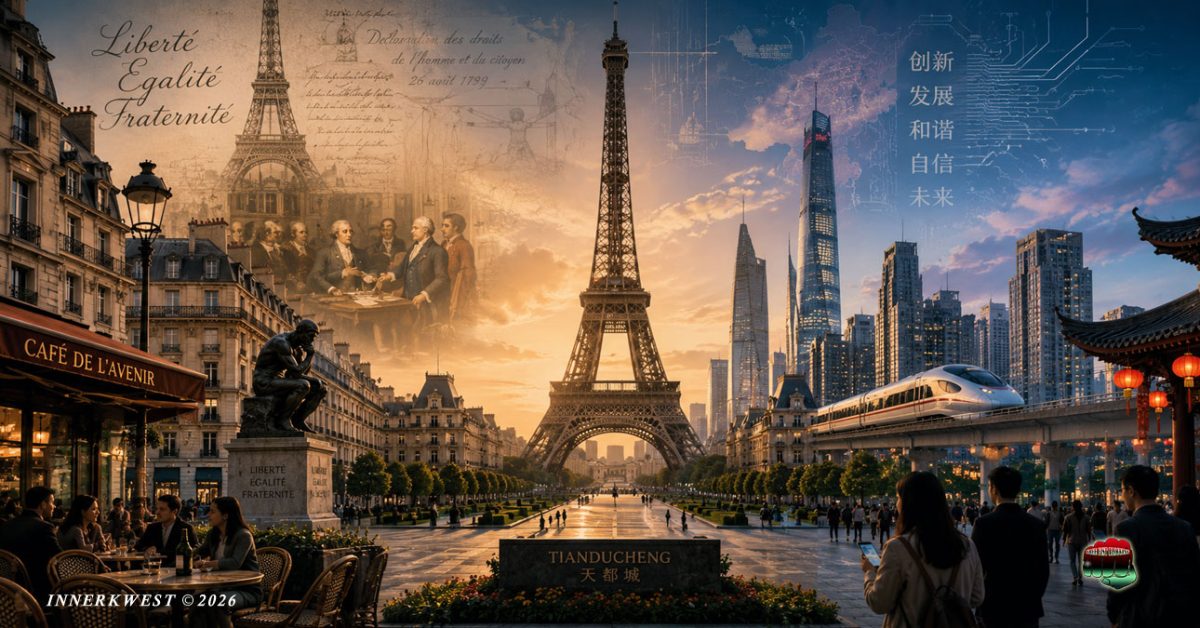
Built near Hangzhou, China, the development became internationally famous for its sweeping Parisian boulevards, European architecture, manicured gardens, and a towering replica of the Eiffel Tower. Western media often treated the project as a curiosity—a strange attempt to recreate one of the world’s most recognizable cities thousands of miles away from France itself.
Yet Tianducheng may be more important than many realize.
Because the deeper question is not why China built a version of Paris.
The deeper question is whether a civilization can borrow the symbols of another civilization while rejecting the values that made those symbols meaningful in the first place.
That question extends far beyond China.
It may ultimately define the twenty-first century.
The Architecture of Admiration
At first glance, Tianducheng appears to suggest admiration for France.
After all, Paris is not merely a city. It is one of the most recognizable cultural symbols on Earth. Its architecture evokes ideas of beauty, sophistication, intellectual life, artistic expression, and public space.
To many in the West, however, Paris represents more than aesthetics.
It also symbolizes the Enlightenment, republican government, political debate, civic identity, and centuries of philosophical inquiry into liberty and the role of the individual within society.
This is where the puzzle begins.
China appears comfortable embracing the architecture while maintaining a governing model that differs sharply from modern French political traditions.
To some observers, that feels contradictory.
To Chinese planners, it may not feel contradictory at all.
Borrowing Without Becoming
Throughout history, powerful civilizations have rarely hesitated to borrow from one another.
The Romans borrowed from Greece.
Europe borrowed mathematics from the Islamic world.
Japan adopted elements of Western industry while retaining distinct cultural traditions.
The United States absorbed ideas, people, technologies, and customs from dozens of civilizations while developing its own identity.
The assumption underlying such borrowing has often been simple: useful ideas should be adopted regardless of where they originate.
China appears to operate from a similar philosophy.
The country has imported global manufacturing techniques, modern finance, advanced engineering, and cutting-edge technologies without accepting the notion that doing so requires adopting Western political structures.
The same principle may explain Tianducheng.
The message is not necessarily, “We wish to become France.”
It may be, “We admire certain outcomes and forms, but we reserve the right to remain ourselves.”
That distinction matters.
The Confidence of Rising Powers
Perhaps the most revealing aspect of Tianducheng is what it says about confidence.
Historically, rising powers often feel pressure to imitate dominant civilizations. They import not only technology and architecture but also political assumptions, institutional frameworks, and cultural preferences.
But civilizations that possess confidence in their own trajectory frequently become more selective.
They borrow what they find useful.
They discard what they do not.
They adapt foreign ideas to domestic realities rather than reshaping themselves to satisfy external expectations.
Viewed through this lens, Tianducheng begins to look less like imitation and more like assertion.
The project suggests a civilization comfortable enough with its own identity to separate aesthetics from ideology.
Whether that separation ultimately succeeds remains an open question.
An African Question Hidden Inside a Chinese Story
The most interesting aspect of Tianducheng may be that it raises questions many African nations are increasingly confronting themselves.
Across the continent, debates continue over:
- economic development models,
- constitutional structures,
- industrial policy,
- financial systems,
- governance frameworks,
- and the relationship between sovereignty and modernization.
For generations, many post-colonial states were encouraged to adopt institutional templates largely developed elsewhere.
Today, however, a growing number of policymakers are asking a different question:
Must development require imitation?
Or can nations selectively adapt external ideas while retaining distinct cultural and political identities?
That question sits beneath discussions involving BRICS, industrial sovereignty, resource nationalism, and emerging multipolar alliances.
In many respects, it is the same question posed by Tianducheng.
Can the form be separated from the philosophy?
Can the building be borrowed without importing the worldview?

More Than a Replica
Perhaps Tianducheng will never be remembered as a great urban-planning achievement.
Perhaps it will remain little more than an unusual footnote in China’s extraordinary rise.
Yet the city reveals something important about the age now unfolding.
The old assumption that modernization requires cultural imitation is increasingly being challenged by rising powers across the world.
China is not the only country asking whether technology, prosperity, and national development can be achieved without adopting every political or philosophical assumption that accompanied them elsewhere.
Africa is asking similar questions.
Parts of Asia are asking similar questions.
Even Western societies are debating which traditions should be preserved and which should be adapted.
In that sense, Tianducheng is not really about Paris at all.
It is about civilizational confidence.
And the possibility that the next era of global development may be defined not by imitation, but by selective adaptation.
The Eiffel Tower may stand at the center of Tianducheng.
The real story, however, is not what China copied.
It is what China chose not to.
At InnerKwest.com, we are committed to delivering impactful journalism, deep insights, and fearless social commentary. Your cryptocurrency contributions help us execute with excellence, ensuring we remain independent and continue to amplify voices that matter.
To help sustain our work and editorial independence, we would appreciate your support of any amount of the tokens listed below. Support independent journalism:
BTC: 3NM7AAdxxaJ7jUhZ2nyfgcheWkrquvCzRm
SOL: HxeMhsyDvdv9dqEoBPpFtR46iVfbjrAicBDDjtEvJp7n
ETH: 0x3ab8bdce82439a73ca808a160ef94623275b5c0a
XRP: rLHzPsX6oXkzU2qL12kHCH8G8cnZv1rBJh TAG – 1068637374
SUI – 0xb21b61330caaa90dedc68b866c48abbf5c61b84644c45beea6a424b54f162d0c
and through our Support Page.
InnerKwest maintains a revelatory and redemptive discipline, relentless in advancing parity across every category of the human experience.
© 2026 InnerKwest®. All Rights Reserved | Haki zote zimehifadhiwa | 版权所有. InnerKwest® is a registered trademark of Inputit™ Platforms Inc. Global. No part of this publication may be reproduced, distributed, or transmitted in any form or by any means without prior written permission. Unauthorized use is strictly prohibited. Thank you for standing with us in pursuit of truth and progress!