
June 8, 2026
By InnerKwest Guest Analysis: Solomon Reed
For decades, discussions surrounding foreign aid in Africa often began with a familiar premise:
What does Africa need?
Today, a different question is increasingly emerging across the continent:
Under what terms should assistance be accepted, and who gets to decide?
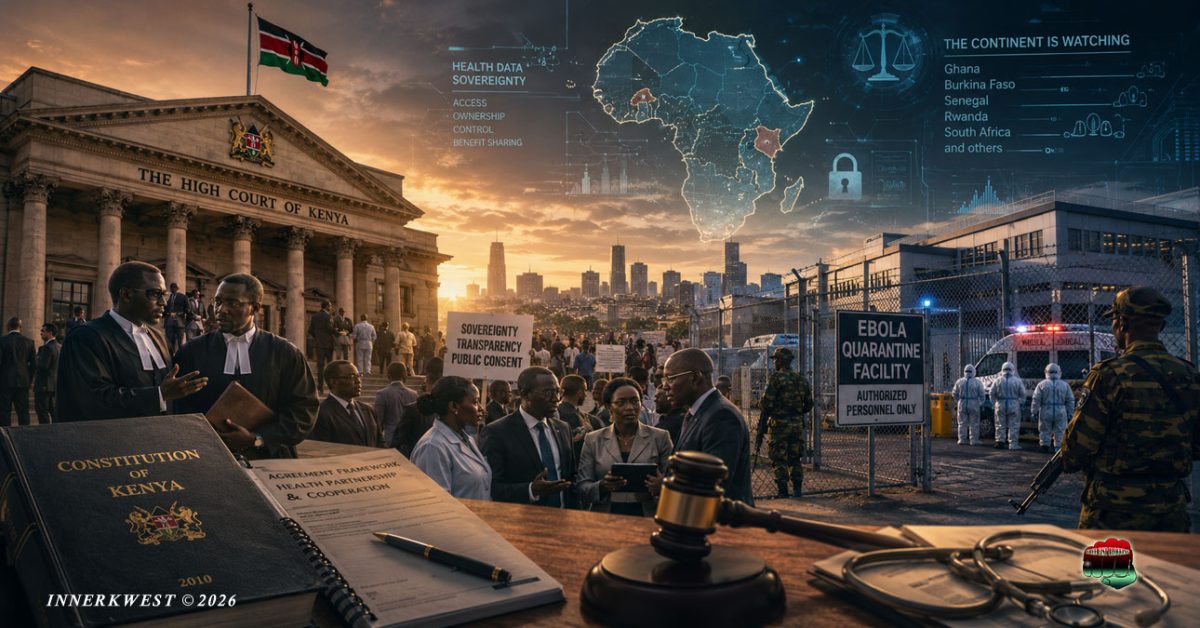
That question sits at the center of a growing controversy in Kenya, where a proposed U.S.-backed Ebola quarantine facility has evolved into something far larger than a public-health debate. What began as a health partnership now touches constitutional authority, judicial oversight, data sovereignty, public consent, and the changing political mood across Africa itself.
The issue is no longer merely about disease prevention.
It is about sovereignty.
The Facility That Sparked a National Debate
The dispute began after reports emerged that Kenya had agreed to host a facility designed to quarantine Americans potentially exposed to Ebola in Central and East Africa.
Supporters of the arrangement described it as a public-health partnership capable of strengthening emergency response capabilities while deepening cooperation between Kenya and the United States.
Critics saw something else entirely.
Questions quickly emerged regarding transparency, risk allocation, public consultation, and the rationale behind locating such a facility in Kenya while the United States maintains its own advanced medical infrastructure.
The controversy intensified when Kenya’s High Court intervened, suspending implementation of the agreement and demanding additional disclosure regarding the terms, legal basis, and operational framework of the arrangement.
That judicial intervention transformed the story.
The debate was no longer simply about Ebola.
It became a constitutional question.
Can an executive branch enter into an international arrangement carrying public-health and sovereignty implications without meaningful judicial review or public scrutiny?
For many Kenyans, the answer appeared increasingly clear.
The court said no.
Sovereignty Beyond the Executive Branch
One of the most significant aspects of the dispute has received comparatively little international attention.
Historically, sovereignty is often discussed through presidents, cabinets, parliaments, and foreign ministries.
In Kenya’s case, however, the judiciary effectively emerged as a sovereignty actor.
By demanding transparency and constitutional review, the courts signaled that sovereignty is not exercised solely through executive agreements. International partnerships remain subject to legal scrutiny, constitutional limitations, and public accountability.
That distinction matters.
Because it suggests a broader institutional maturity increasingly visible across portions of Africa.
The question is no longer whether governments possess the authority to enter international partnerships.
The question is whether those partnerships can withstand public examination once citizens and constitutional institutions become involved.
The Health Data Question
The Kenya dispute is unfolding against a larger backdrop of growing concern surrounding health-data sovereignty across Africa.
Recent reports indicate that several African governments have expressed reservations regarding proposed international health arrangements involving access to health information, pathogen samples, and broader public-health infrastructure.
In previous decades, such agreements might have been viewed primarily through the lens of aid and technical assistance.
Today, many policymakers view them differently.
Data has become a strategic asset.
Health information is no longer merely administrative information. It increasingly intersects with biotechnology, pharmaceutical development, artificial intelligence, epidemiological research, and national security considerations.
As a result, governments are beginning to ask questions that would have sounded unusual a generation ago:
Who owns the data?
Who controls access?
Who benefits from future discoveries?
And who determines how national health information is ultimately used?
These are not anti-science questions.
They are sovereignty questions.
A Different Africa Is Emerging
The deeper significance of the Kenya controversy may have little to do with any single facility.
Instead, it reflects a broader shift in political posture visible across parts of the continent.
For much of the post-colonial era, African governments often operated within international systems where external funding, technical assistance, and development partnerships carried significant influence over domestic decision-making.
That reality has not disappeared.
But it is increasingly being challenged.
Across Africa, debates surrounding:
- industrial policy,
- resource management,
- foreign military agreements,
- health infrastructure,
- development financing,
- and data governance
are increasingly being filtered through the language of sovereignty.
The conversation is evolving.
The question is no longer simply whether assistance is available.
The question increasingly becoming important is what accompanies that assistance.
Why the Continent Is Watching
The significance of the Kenyan dispute extends far beyond Nairobi.
Governments throughout Africa are confronting similar questions involving constitutional authority, foreign partnerships, transparency, and strategic assets.
Whether the issue involves minerals, infrastructure, financial agreements, digital systems, or public health, the underlying concern remains remarkably consistent:
Who gets to decide?
Kenya’s response is therefore being watched not because every nation faces identical circumstances, but because the dispute touches questions many governments are increasingly confronting themselves.
Can international agreements proceed without public disclosure?
What role should courts play in reviewing foreign partnerships?
Where should executive authority end and constitutional oversight begin?
And perhaps most importantly, how should African states balance cooperation with sovereignty?
These questions are unlikely to disappear.
The New Negotiation
The controversy surrounding the Ebola facility may ultimately reveal a broader transformation underway across parts of Africa.
For decades, many international discussions focused on what external actors were willing to provide.
Increasingly, African societies are asking what they are being asked to contribute in return.
That contribution may include:
- land,
- resources,
- infrastructure,
- data,
- biological samples,
- institutional access,
- or public-health systems.
The point is not that such exchanges are inherently inappropriate.
The point is that they are increasingly being examined rather than assumed.
That distinction represents a meaningful political shift.
It suggests a growing expectation that international partnerships, regardless of how powerful the partner may be, should operate within the boundaries of constitutional legitimacy, public transparency, and informed consent.
Sovereignty Requires Consent
The dispute unfolding in Kenya is not simply about an Ebola facility.
It is about process.
It is about accountability.
And ultimately, it is about consent.
The most consequential development may not be whether the facility is ultimately approved or rejected. It may be the assertion by courts, civil society, and ordinary citizens that agreements carrying national implications must withstand public scrutiny.
That is a conversation extending far beyond Kenya.
Across parts of Africa, sovereignty is increasingly being discussed not as a symbolic concept but as a practical one. The debate is moving beyond flags and speeches toward questions of authority, transparency, oversight, and control.
Partnership remains important.
Cooperation remains important.
But a growing number of Africans appear increasingly determined to ensure that neither comes at the expense of informed national consent.
The court said no.
The larger question now is whether the continent is beginning to say the same thing.

At InnerKwest.com, we are committed to delivering impactful journalism, deep insights, and fearless social commentary. Your cryptocurrency contributions help us execute with excellence, ensuring we remain independent and continue to amplify voices that matter.
To help sustain our work and editorial independence, we would appreciate your support of any amount of the tokens listed below. Support independent journalism:
BTC: 3NM7AAdxxaJ7jUhZ2nyfgcheWkrquvCzRm
SOL: HxeMhsyDvdv9dqEoBPpFtR46iVfbjrAicBDDjtEvJp7n
ETH: 0x3ab8bdce82439a73ca808a160ef94623275b5c0a
XRP: rLHzPsX6oXkzU2qL12kHCH8G8cnZv1rBJh TAG – 1068637374
SUI – 0xb21b61330caaa90dedc68b866c48abbf5c61b84644c45beea6a424b54f162d0c
and through our Support Page.
InnerKwest maintains a revelatory and redemptive discipline, relentless in advancing parity across every category of the human experience.
© 2026 InnerKwest®. All Rights Reserved | Haki zote zimehifadhiwa | 版权所有. InnerKwest® is a registered trademark of Inputit™ Platforms Inc. Global. No part of this publication may be reproduced, distributed, or transmitted in any form or by any means without prior written permission. Unauthorized use is strictly prohibited. Thank you for standing with us in pursuit of truth and progress!