
August 14, 2026
The U.S. Constitution still grants Congress the authority to commission private actors in times of conflict. Although the practice disappeared more than a century ago, emerging threats in cyberspace, private military contracting, and geopolitical competition are prompting a renewed examination of one of America’s most overlooked war powers.
By InnerKwest Editorial Desk
The Constitution’s Forgotten War Power
Constitutions are often viewed as static documents—collections of powers either exercised regularly or relegated to history. Yet some authorities never disappear. They simply remain dormant, waiting for circumstances that may once again test their relevance.
One of the least discussed examples in the United States Constitution is Congress’s authority to issue Letters of Marque and Reprisal.
The phrase sounds as though it belongs in a museum beside wooden sailing ships, iron cannons, and naval battles fought under billowing canvas. Yet it remains embedded within the Constitution itself.
The authority has never been repealed.
The question, therefore, is not whether it exists.
The question is why it still exists—and whether modern conflict could cause policymakers to look at it through an entirely different lens.
An Authority Older Than the Republic
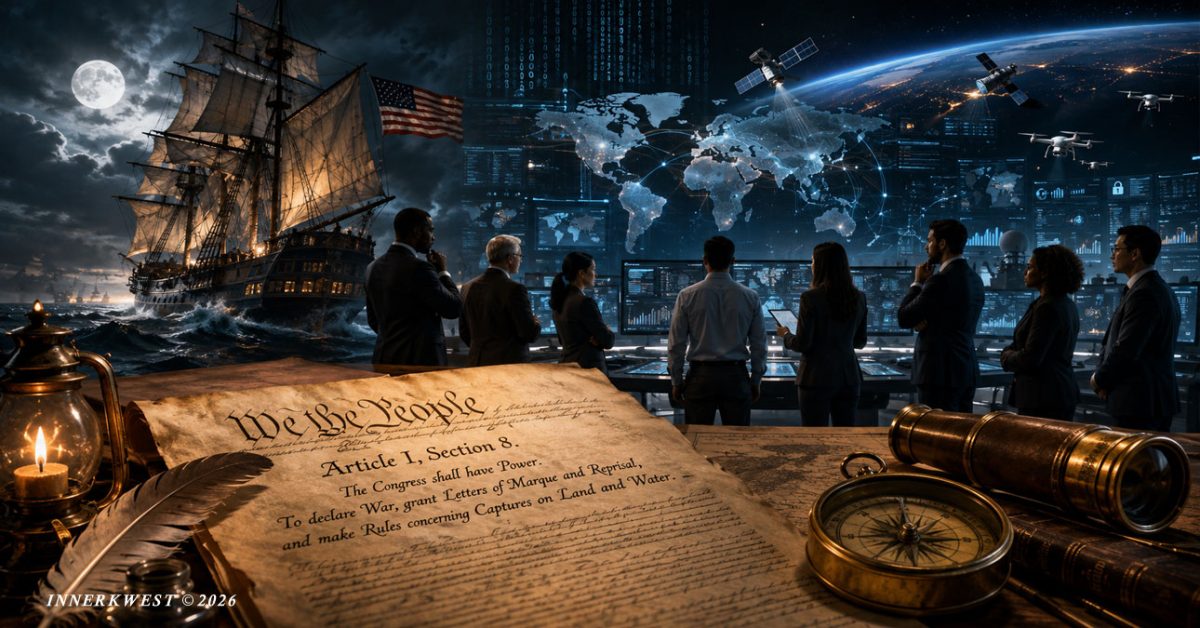
Article I, Section 8 grants Congress the authority to:
“Declare War, grant Letters of Marque and Reprisal, and make Rules concerning Captures on Land and Water.”
Most Americans recognize Congress’ authority to declare war.
Far fewer recognize that the same sentence authorizes Congress to commission private citizens to act on behalf of the United States during conflict.
Historically, these commissions transformed privately owned vessels into legally recognized instruments of national policy.
Without such authorization, attacking another nation’s shipping constituted piracy.
With congressional authorization, the same vessel became a privateer operating under the laws of war.
The distinction was not philosophical.
It was legal.
Pirates Versus Privateers
Popular culture has blurred the distinction between piracy and privateering.
Pirates operated independently.
They recognized no government.
They attacked anyone capable of producing profit.
Privateers, however, operated under explicit governmental authority.
They were commissioned.
Their targets were restricted.
Captured vessels were subject to judicial review through prize courts.
Their authority could be revoked.
In many respects, they functioned as contractors performing missions traditionally associated with state militaries.
That distinction remains significant because it demonstrates something larger about constitutional design.
The Framers acknowledged that national security could, under carefully defined circumstances, involve both public institutions and private actors.
Why the Young United States Needed Privateers
During the Revolutionary War, the United States possessed little naval capability.
Building a professional navy required years.
The conflict could not wait.
Private merchant vessels therefore became force multipliers.
Congress issued commissions permitting American captains to disrupt British commerce, seize cargo, and weaken the economic foundations supporting Britain’s military campaign.
The strategy reflected necessity more than ideology.
A nation with limited military resources leveraged private capability to offset strategic weakness.
History often repeats itself—not by duplicating technology, but by reproducing incentives.
Modern Conflict Looks Different
The oceans remain strategically important.
Yet today’s conflicts increasingly occur elsewhere.
Computer networks.
Financial infrastructure.
Communications systems.
Artificial intelligence.
Critical infrastructure.
Commercial satellites.
Supply chains.
Private cloud platforms.
Much of the infrastructure supporting modern civilization is no longer owned directly by governments.
It belongs to private corporations.
That reality creates an interesting constitutional question.
If private vessels once supplemented national defense, what constitutes the modern equivalent?
The Rise of the Private National Security Ecosystem
Today’s geopolitical landscape already includes organizations performing functions once reserved almost exclusively for governments.
Private military contractors.
Cybersecurity firms.
Commercial satellite operators.
Space launch companies.
Artificial intelligence laboratories.
Intelligence contractors.
Cloud infrastructure providers.
None of these organizations are privateers.
Yet each demonstrates the increasing role private capability plays in national security.
As technological competition intensifies, governments increasingly depend upon privately owned infrastructure and expertise.
The boundary separating public authority from private capability continues to evolve.
Why Letters of Marque Are Being Discussed Again
Although Congress has not issued Letters of Marque for generations, the concept periodically returns to public discussion.
Various proposals have suggested adapting the constitutional authority to confront modern threats ranging from piracy and terrorism to cyber operations and transnational criminal organizations.
None of these proposals have become law.
Nevertheless, their recurring appearance reveals something important.
The constitutional provision is not viewed merely as historical curiosity.
It remains legally available.
Whether it should ever be exercised is an entirely different question.
Dormant Powers Deserve Attention
History teaches an important lesson.
Governments rarely create entirely new authorities during periods of crisis.
More commonly, they rediscover existing ones.
Emergency powers.
Defense production authorities.
Economic sanctions.
National guard mobilizations.
Continuity plans.
Constitutional provisions that remain largely unnoticed during ordinary times often become subjects of renewed interest when circumstances change.
Letters of Marque fit comfortably within that category.
Cyber Privateering?
Imagine a future in which hostile foreign criminal organizations launch sustained cyberattacks against critical infrastructure.
Imagine sophisticated ransomware operations targeting hospitals, transportation networks, or financial institutions.
Would Congress ever authorize carefully regulated private cybersecurity organizations to conduct limited offensive operations under federal supervision?
Such a framework would raise profound constitutional, legal, diplomatic, and ethical questions.
International law.
Civilian protections.
Attribution.
Escalation.
Oversight.
Accountability.
The purpose of asking the question is not to advocate such a policy.
Rather, it illustrates how technological change can cause centuries-old constitutional language to acquire unexpected relevance.
The Technology Question
Every generation inherits constitutional language written for another era.
The challenge lies not in rewriting the Constitution whenever technology evolves.
It lies in interpreting enduring principles amid changing circumstances.
Wooden ships became steel fleets.
Telegraphs became satellites.
Paper intelligence became quantum computing.
Horse-mounted couriers became autonomous systems.
The technologies transformed.
The constitutional questions often remained surprisingly familiar.

Why This Matters
The discussion surrounding Letters of Marque is ultimately not about pirates.
Nor is it about nostalgia for naval warfare.
It is about understanding how constitutional systems preserve authorities whose significance may only become apparent decades—or centuries—later.
History demonstrates that forgotten provisions frequently become relevant precisely because no one expected them to.
That reality invites a broader question.
How many other constitutional authorities remain quietly embedded within the American system, awaiting circumstances that future generations have not yet imagined?
Perhaps the Constitution’s most interesting powers are not the ones dominating today’s headlines.
Perhaps they are the ones few people remember until history circles back around.
At InnerKwest.com, we are committed to delivering impactful journalism, deep insights, and fearless social commentary. Your cryptocurrency contributions help us execute with excellence, ensuring we remain independent and continue to amplify voices that matter.
To help sustain our work and editorial independence, we would appreciate your support of any amount of the tokens listed below. Support independent journalism:
BTC: 3NM7AAdxxaJ7jUhZ2nyfgcheWkrquvCzRm
SOL: HxeMhsyDvdv9dqEoBPpFtR46iVfbjrAicBDDjtEvJp7n
ETH: 0x3ab8bdce82439a73ca808a160ef94623275b5c0a
XRP: rLHzPsX6oXkzU2qL12kHCH8G8cnZv1rBJh TAG – 1068637374
SUI – 0xb21b61330caaa90dedc68b866c48abbf5c61b84644c45beea6a424b54f162d0c
and through our Support Page.
InnerKwest maintains a revelatory and redemptive discipline, relentless in advancing parity across every category of the human experience.
© 2026 InnerKwest®. All Rights Reserved | Haki zote zimehifadhiwa | 版权所有. InnerKwest® is a registered trademark of Inputit™ Platforms Inc. Global. No part of this publication may be reproduced, distributed, or transmitted in any form or by any means without prior written permission. Unauthorized use is strictly prohibited. Thank you for standing with us in pursuit of truth and progress!