
October 12, 2026
By the InnerKwest Editorial Desk
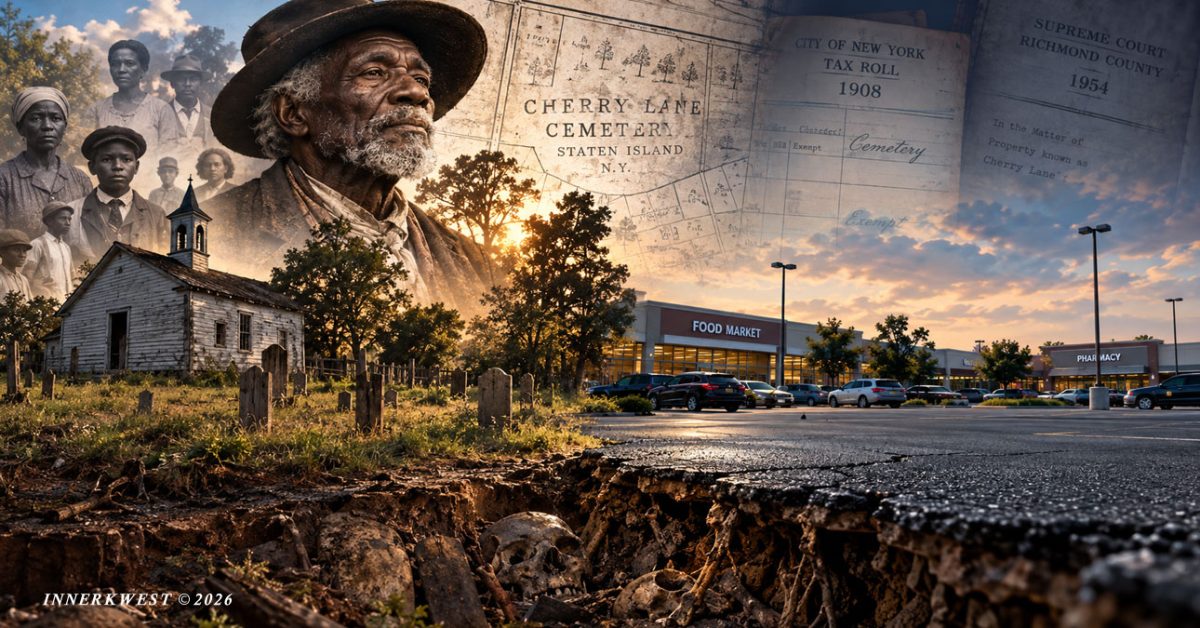
There is a shopping center on Forest Avenue in Staten Island where the history is easier to drive over than to see.
Cars enter from the street. Shoppers cross the parking lot. Businesses open and close. Deliveries arrive. Asphalt covers most of the ground, and nothing about the ordinary rhythm of the place requires a visitor to consider who may still be beneath it.
But this was once Cherry Lane Cemetery.
It has been called the Old Slave Burying Ground, the African Burial Ground and the Second Asbury African Methodist Episcopal Church Cemetery. The names changed across generations and records. The essential fact did not. Black Staten Islanders buried their dead there.
Some had been enslaved. Some were born free. They were laborers, oystermen, working families, children and members of a Black community establishing institutions of its own during a century in which freedom under law did not necessarily confer equality in life.
That distinction matters.
Calling Cherry Lane simply a “slave cemetery” captures attention but compresses the people buried there into the condition imposed upon some of them. Cherry Lane continued beyond slavery. It belonged to the larger story of Black families building churches, acquiring property, burying parents and children, and constructing community in a country still deciding how much of their citizenship it intended to recognize.
Today, the cemetery is largely invisible.
The dead are another matter.
Before the Parking Lot
The documented story reaches at least to 1850, when John W. Blake and his wife, Tabitha, conveyed property to the Second Asbury African Methodist Episcopal Church. A church and burial ground developed on the land.
This was not unusual in the way America often required Black institutions to develop separately. Churches became more than houses of worship. They were schools, meeting places, political spaces, mutual-aid networks and repositories of community memory. A cemetery connected to such a church was not merely vacant land reserved for graves. It was part of the architecture of a community.
By 1889, historian William T. Davis visited the location and recorded what he saw.
The church itself had disappeared, but the burial ground had not. Graves remained. Some were marked not by carved stone but by wooden stakes.
That seemingly minor detail would become consequential.
Stone survives differently than wood.
So does wealth.
A prosperous family can place granite over its dead and reasonably expect the marker to outlive the people who erected it. A poor family may rely upon timber, an arrangement of stones, a depression in the earth or the knowledge carried by neighbors who know that someone rests there.
When those markers deteriorate, the burial does not cease to have happened.
Only its visibility changes.
Cherry Lane appears to have entered that dangerous territory early: the place remained a cemetery, but increasingly fewer physical objects above ground announced that fact to someone who did not already know.
Yet documentary evidence survived.
Historical maps identified the cemetery. Death records and obituaries connected individuals to it. Researchers have since reconstructed dozens of burials from records scattered across archives and family histories.
Among them was Benjamin Prine.
A Man Remembered, a Grave Nearly Lost
Prine’s life stretched across an extraordinary period of American history.
Born into slavery in the eighteenth century, he lived long enough to enter the twentieth. Historical accounts describe his work around New York Harbor, his connection to fortification work during the War of 1812 and his later life on Staten Island. When he died in 1900, he was buried at Cherry Lane.
More than a century later, his name would return to the landscape.
Benjamin Prine Way was dedicated near the former cemetery in 2023. His descendants became involved in efforts to recover the history of the burial ground. The Cherry Lane Memorial Garden followed in 2024.
The recognition is important.
It also raises an uncomfortable question.
How does a community go from burying a man whose life reached back into American slavery to requiring descendants generations later to help prove where he was buried?
There was no single moment when Cherry Lane disappeared.
That may be the most important thing to understand about it.
Erasure is sometimes imagined as an event: someone removes a marker, destroys a document, changes a name or orders a building demolished.
Cherry Lane appears to have experienced something slower.
Wooden markers disappeared.
The church disappeared.
Institutional continuity weakened.
Records became separated from one another.
Property administration took on increasing importance.
Eventually, what was visible on the ground and what existed inside government records no longer necessarily told the same story.
When Paper Begins to Compete With Memory
One of the most consequential records identified by researchers comes from 1908.
Research associated with the Black Cemetery Network reports that New York City tax rolls recognized Cherry Lane as a tax-exempt cemetery at that time.
InnerKwest has not yet independently examined the original 1908 tax entry, and that distinction is important. The finding is supported by researchers who have spent considerable time reconstructing Cherry Lane, but the original municipal record is among the documents this publication continues to seek.
If confirmed in the underlying record, its significance is difficult to miss.
The government would not merely have inherited a later community claim that the property once contained a cemetery.
Its own records would have recognized one.
Then something changed.
In 1927, the African Methodist Church Cemetery of Staten Island, Inc. was created, and the property was transferred into the cemetery organization. Historical research indicates, however, that the new organization apparently failed to properly notify the relevant tax or real-property authorities of the cemetery’s status.
That administrative failure cannot simply be discarded because it complicates the story.
It should be confronted.
The trustees responsible for protecting the cemetery appear to have made mistakes. Records were not maintained or communicated as they should have been. An institution serving a Black community could be vulnerable not only to discrimination from outside but to limited resources, changing generations and administrative failures within.
But another question follows.
Should a filing failure change what land physically contains?
There is a difference between failing to properly register a cemetery and a cemetery ceasing to exist.
Cherry Lane exposes the distance between those two propositions.
A government database can be wrong.
A deed can be incomplete.
A tax classification can change.
None of them can unbury a body.
The Years That Require More Answers
By the middle of the twentieth century, tax obligations had become central to Cherry Lane’s fate.
This is also where the surviving accounts become less orderly.
Historical reconstructions do not entirely agree about the sequence between approximately 1950 and 1956. Some research places a city seizure for unpaid taxes in 1950 and describes a negotiated settlement and sale involving Sidelle Mann in 1953. More recent research and public testimony place critical legal action in 1954, describe tax liabilities exceeding $16,000 and identify subsequent proceedings through which the property’s status as a cemetery was effectively extinguished.
There are differences in the amounts.
There are differences in the dates.
There are differences in descriptions of the legal mechanism.
Those discrepancies should not be forced into agreement merely because a clean chronology would make a cleaner article.
What can be established is more important.
The cemetery accumulated substantial tax liabilities. Control of the property changed. Litigation followed. The physical evidence above ground had become sparse. And at some point during these proceedings, the proposition that the property was not legally a cemetery prevailed.
Researchers examining the case have identified an especially troubling allegation in the surviving legal history: sworn testimony reportedly denied that burials had occurred on the property.
That assertion sits uneasily beside another body of evidence.
People had been buried there.
William T. Davis had observed the burial ground decades earlier. Maps identified it. Death records identified burials. Obituaries did the same. Benjamin Prine was not an abstraction invented after commercial development arrived.
Neither were the others.
This is where Cherry Lane becomes something larger than the history of one cemetery.
The issue is not simply whether somebody lied, whether an official was indifferent or whether a developer behaved badly. Those questions may eventually be answerable as additional documents emerge.
The deeper problem is how institutions determine what constitutes reality.
At Cherry Lane, historical reality and administrative reality appear to have separated.
And administrative reality won.
The Absence of a Headstone
There is a particularly uncomfortable logic buried within the history.
As the cemetery deteriorated, fewer visible markers remained.
The fewer markers that remained, the easier it became to describe the property as vacant.
And once land could be described as vacant, the absence of visible graves could itself become evidence that there had never been a cemetery.
The reasoning risks becoming circular.
There are no markers, therefore there are no graves.
There are no graves, therefore the property is not a cemetery.
The property is not a cemetery, therefore the protections afforded cemeteries need not follow the land.
But return to 1889.
Some graves were marked with wooden stakes.
Wood rots.
That simple fact belongs in this history.
So does the economic reality behind it.
America’s historic landscapes are filled with monuments built by people who possessed the resources to make memory durable. Marble courthouses survive. Stone churches survive. Bronze statues survive. Family mausoleums survive.
The poor often left less permanent evidence.
For Black communities emerging from slavery, segregation and economic exclusion, that disparity carried consequences extending even into the treatment of the dead.
If preservation depends upon what survives above ground, inequality can reproduce itself long after burial.
One community leaves granite.
Another leaves wood.
A century later, one appears historical.
The other appears empty.
Commerce Arrives
Cherry Lane eventually entered the commercial landscape.
A gasoline station occupied the property. Later came the shopping center.
Concrete and asphalt changed what visitors could see, but they did not resolve the fundamental question of what remained below.
There is no established record demonstrating that all of the people buried at Cherry Lane were systematically exhumed and reinterred elsewhere before commercial development.
That point requires precision.
It is sometimes said that approximately 1,000 enslaved people remain beneath the shopping center. The available evidence does not presently justify stating that as established fact.
Researchers have individually documented dozens of people buried at Cherry Lane. Historical estimates of the total number of burials vary considerably. Some of those interred had experienced slavery; others were free Black Staten Islanders and descendants of the community that developed around Second Asbury.
The exact number matters.
But uncertainty about the number should not be confused with uncertainty about the cemetery.
Those are different questions.
We may not know precisely how many people were buried there.
We know people were.
When the Ground Begins Speaking Again
Cherry Lane did not return to public consciousness because the property suddenly revealed itself.
People went looking.
Historians searched old maps. Genealogists followed names. Researchers compared death certificates with property records. Descendants reconstructed family histories. Community advocates began asking why a burial ground had disappeared from the landscape.
Filmmaker Heather Quinlan has become one of the prominent figures in that effort. Her work on what is now American Graveyard has brought renewed attention to Cherry Lane and to the unresolved history beneath the property.
The Black Cemetery Network has helped document individuals associated with the cemetery.
Descendants have returned names to people who had increasingly become numbers.
And the government has returned to the story as well.
In September 2026, the New York City Council approved legislation requiring greater identification and documentation of historical African-American burial grounds, including plans for locating unmarked sites and improving public recognition of them.
Cherry Lane helped give the legislation urgency.
There is something both encouraging and sobering about that.
A government capable of losing sight of a burial ground can also become an instrument for recovering it.
Institutions are not static things. They inherit failures, but they can also examine them.
That does not restore what was lost.
It does establish responsibility for what happens next.
Cherry Lane Was Not Alone
New York has encountered this history before.
African-American burial grounds have disappeared beneath development, become vacant lots, been rediscovered during construction or survived for generations without the recognition afforded better-protected cemeteries.
That larger pattern prevents Cherry Lane from being dismissed as an eccentric property dispute on Staten Island.
But neither should every lost Black cemetery be forced into one explanation.
Some were overtaken by development. Some suffered neglect. Some became casualties of incomplete records. Some encountered government decisions made during periods when Black historical preservation carried little institutional weight. Some were harmed by several of these forces at once.
Cherry Lane appears to belong to that more complicated category.
No single villain is required.
That may be the more disturbing conclusion.
A cemetery can disappear through accumulated decisions made by people who never meet one another.
One generation fails to maintain records.
Another fails to maintain markers.
An office changes a classification.
Taxes accumulate.
A lawyer examines the title.
A court considers the evidence presented to it.
A purchaser acquires property.
A developer sees commercially useful land.
Concrete arrives.
Everyone performs a discrete function.
At the end of the process, a cemetery is gone.
Except it isn’t.
What the Law Can Erase
The temptation with Cherry Lane is to end with the parking lot.
That would give the story a powerful image, but it would leave the wrong impression.
The real subject is not asphalt.
It is the authority societies give documents to define reality.
Property law requires certainty. Governments require records. Courts must decide between competing claims. Developers need titles upon which they can rely. None of those requirements is inherently sinister.
But Cherry Lane asks what happens when the record becomes cleaner than the history.
A court can determine ownership.
A government can impose taxes.
A deed can transfer property.
A zoning designation can permit commerce.
A developer can pour concrete.
Those actions can determine what people are legally permitted to do with land.
They cannot determine what happened there.
Somewhere beneath all the property descriptions, tax assessments, corporate filings and legal proceedings were human beings whose families placed them in the earth believing they had reached their final resting place.
The law could change the status of the property.
It could not change that.
Today there is a memorial garden. There is Benjamin Prine Way. There are descendants, researchers and public officials saying the names again. There is legislation intended to make other burial grounds harder to lose.
And there remains an unfinished documentary record.

A Continuing Record
InnerKwest has relied upon historical accounts, municipal materials, cemetery research, public testimony, maps, genealogical records and other presently available documentation in reconstructing the history of Cherry Lane. Some portions of the property’s mid-twentieth-century legal history remain unresolved.
Published accounts differ on important details surrounding the tax proceedings, transfer of the property and litigation occurring between approximately 1950 and 1956. InnerKwest is continuing to seek the underlying tax records, deeds, court filings, judgments and related documents necessary to reconcile those accounts.
Where the surviving record establishes a fact, this investigation says so. Where researchers disagree or the primary document has not yet been located, we have attempted to make that distinction equally clear.
This article will be updated when appropriate documentation becomes available.
The uncertainty surrounding those records does not alter what the historical evidence already establishes.
Cherry Lane was a burial ground.
People were laid to rest there.
What remains to be more completely understood is how a place that existed so clearly in the lives and deaths of one community could become so uncertain in the records of another. Prove it.
At InnerKwest.com, we are committed to delivering impactful journalism, deep insights, and fearless social commentary. Your cryptocurrency contributions help us execute with excellence, ensuring we remain independent and continue to amplify voices that matter.
To help sustain our work and editorial independence, we would appreciate your support of any amount of the tokens listed below. Support independent journalism:
BTC: 3NM7AAdxxaJ7jUhZ2nyfgcheWkrquvCzRm
SOL: HxeMhsyDvdv9dqEoBPpFtR46iVfbjrAicBDDjtEvJp7n
ETH: 0x3ab8bdce82439a73ca808a160ef94623275b5c0a
XRP: rLHzPsX6oXkzU2qL12kHCH8G8cnZv1rBJh TAG – 1068637374
SUI – 0xb21b61330caaa90dedc68b866c48abbf5c61b84644c45beea6a424b54f162d0c
and through our Support Page.
InnerKwest maintains a revelatory and redemptive discipline, relentless in advancing parity across every category of the human experience.
© 2026 InnerKwest®. All Rights Reserved | Haki zote zimehifadhiwa | 版权所有. InnerKwest® is a registered trademark of Inputit™ Platforms Inc. Global. No part of this publication may be reproduced, distributed, or transmitted in any form or by any means without prior written permission. Unauthorized use is strictly prohibited. Thank you for standing with us in pursuit of truth and progress!