
October 14, 2026
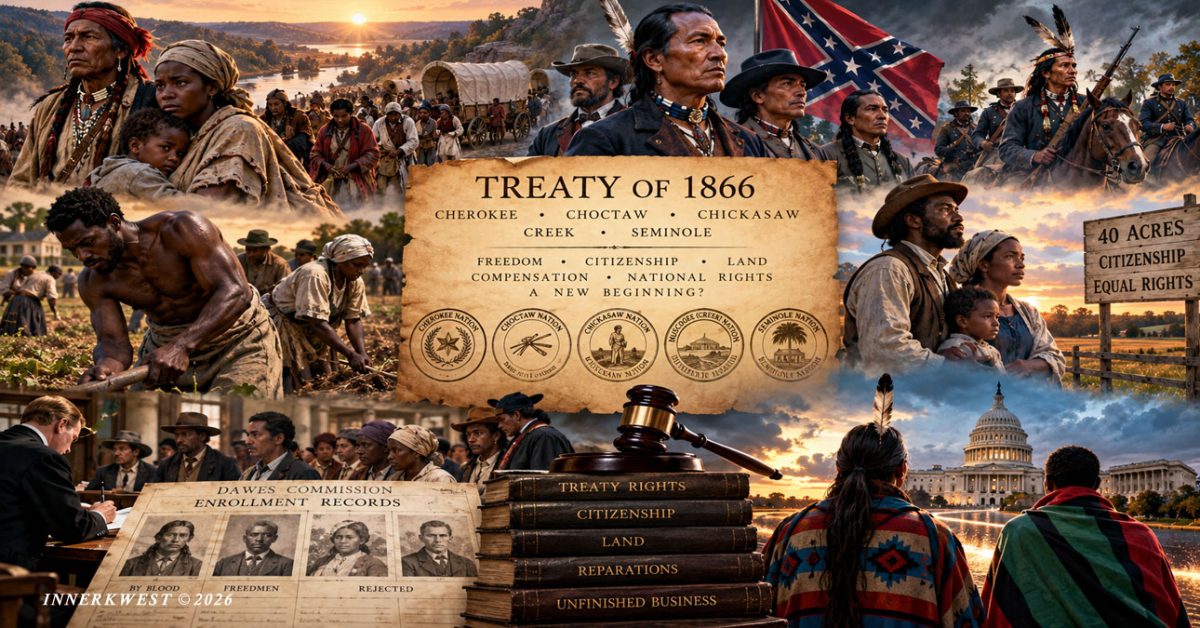
Five Native American nations entered the Civil War era with systems of African enslavement, and their governments eventually entered treaties with the Confederacy. When the war ended, the United States negotiated new treaties promising freedom and varying rights to formerly enslaved people. The struggle over those promises exposes a chapter of American Reconstruction that remains unresolved in important respects.
By InnerKwest Editorial Desk
The history of American slavery is generally told through a familiar geography: Southern plantations, cotton fields, slave auctions, the Confederacy, and the struggle for emancipation. Less frequently examined is the system of African enslavement that developed within several Native American nations, the alliances their governments formed with the Confederacy, and the consequences for the people they held in bondage.
This history complicates conventional accounts of American slavery without diminishing the enormous injustices inflicted upon Native Americans themselves.
The Cherokee, Choctaw, Chickasaw, Muscogee (Creek), and Seminole nations experienced forced removal, territorial dispossession, federal coercion, and repeated violations of their sovereignty. Yet within these same nations, citizens also participated in the enslavement of African Americans. Some became substantial slaveholders. Others resisted slavery, opposed Confederate alliances, or fought for the Union.
The contradictions became unavoidable during the Civil War.
By 1866, the United States had negotiated new treaties with all five nations. Those agreements abolished slavery, addressed the status of formerly enslaved people, and established different arrangements involving citizenship, land, compensation, and national resources.
For the African Americans who had lived under bondage within these nations, emancipation was supposed to mark the beginning of a new legal relationship.
But freedom and recognition would prove to be different things.
The central question is not simply whether the treaties promised rights. Their language establishes that they did.
The more consequential question is how those rights were interpreted, administered, restricted, and, in some cases, restored over the following 160 years.
A History That Did Not Begin in 1866
Long before the Civil War, the expansion of plantation agriculture across the southeastern United States had drawn some Native American elites into the economic institutions of the American South.
Among the Cherokee, Choctaw, Chickasaw, Creek, and Seminole nations, relationships with people of African descent varied considerably. Some African Americans lived in communities where they maintained degrees of autonomy. Others were held in hereditary chattel slavery, subjected to forced labor, restrictions on movement, and the denial of legal independence.
Slaveholding was not universal within these nations. It was concentrated among particular households and economic groups, with substantial differences between nations. Nevertheless, it became sufficiently established that tribal governments adopted laws regulating slavery and restricting the rights of enslaved people.
The United States Department of the Interior has acknowledged that citizens of all five nations enslaved people and that their governments enacted laws supporting slavery or limiting the rights of enslaved Africans.
The significance of that acknowledgment extends beyond identifying individual slaveholders.
Slavery had become part of the institutional structure of these societies. It influenced property ownership, agricultural production, household wealth, political relationships, and the legal status of African Americans living within their boundaries.
In some households, enslaved people worked agricultural land, maintained domestic establishments, raised livestock, and performed skilled labor. Their labor contributed to wealth that could be inherited, transferred, or used to expand economic enterprises.
For those enslaved, the identity of the slaveholder did not change the essential condition of bondage.
The legal system might be different. The surrounding political institutions might be different. But the enslaved person remained subject to another person’s asserted ownership.
That reality would follow African Americans westward when the federal government forced the removal of Native nations from their ancestral homelands.
The Trail of Tears Had African American Victims
The forced removals of the 1830s remain among the most devastating episodes in the history of the United States.
Federal policies displaced Native communities from their southeastern homelands and compelled their relocation to Indian Territory, primarily in what is now Oklahoma. Families lost property, communities were fractured, and thousands suffered through disease, exposure, deprivation, and death.
But the forced migrations included another population whose presence receives comparatively limited attention.
Enslaved African Americans accompanied Native slaveholders westward.
They traveled within the same machinery of removal, although their circumstances were shaped by the additional coercion of enslavement. Some were compelled to transport property, manage livestock, prepare food, and perform labor during the journey.
For these individuals, removal did not represent the loss of an independent homeland followed by the restoration of freedom elsewhere. They were forcibly displaced while remaining legally enslaved.
The Government Accountability Office’s 2026 examination of Freedmen descendants explicitly recognizes that enslaved people and other persons of African descent were among those removed with the Five Tribes during the 1830s.
This intersection matters because the two histories are often separated in public memory.
Native Americans were victims of federal dispossession. African Americans were victims of enslavement within Native societies. In some instances, the same historical episode involved both populations, but their legal positions were fundamentally different.
The United States could be responsible for the forced displacement of a Native nation while members of that nation simultaneously exercised ownership over enslaved Africans.
Recognizing both circumstances does not require minimizing either injustice.
It requires understanding how systems of domination could overlap, even among communities experiencing oppression themselves.
When the Confederacy Entered Indian Territory
The outbreak of the Civil War in 1861 confronted Native governments with a dangerous political and military calculation.
Indian Territory occupied a strategically important position between Union-controlled areas and Confederate states. Federal military withdrawals left communities vulnerable, while Confederate officials pursued alliances promising protection, recognition, and economic relationships.
For some Native leaders, Confederate partnership appeared to offer an alternative to a federal government that had repeatedly violated treaties and confiscated ancestral lands.
For others, especially slaveholding elites whose economic interests were connected to the southern plantation system, the Confederacy offered a political order committed to preserving slavery.
Those motivations were not identical, but they could reinforce one another.
All five nations eventually entered treaties with the Confederacy. Yet their governments and populations were divided, and the alliances cannot accurately be interpreted as unanimous expressions of Native opinion.
The Choctaw and Chickasaw governments aligned relatively quickly with the Confederacy. Among the Cherokee, Creek, and Seminole, internal divisions were particularly consequential.
The Confederate agreements brought Native political authorities into a rebellion whose central institution was slavery.
That relationship must be examined without obscuring the resistance that existed within Native communities.
Some Native Americans rejected Confederate alliances, remained loyal to the Union, or joined federal military formations. Others fought to defend their homes and communities amid a conflict that increasingly resembled an internal civil war within Indian Territory.
Creek leader Opothleyahola organized a Union-loyalist movement that included Native Americans and people of African descent. Confederate-aligned forces attacked the movement, driving refugees toward Kansas through a bitter winter.
The resulting humanitarian disaster became associated with the Trail of Blood on the Ice.
The war therefore produced competing Native military forces, divided families, displaced communities, and African Americans whose prospects for freedom depended partly on which forces prevailed.
The Cherokee General Who Fought for the Confederacy
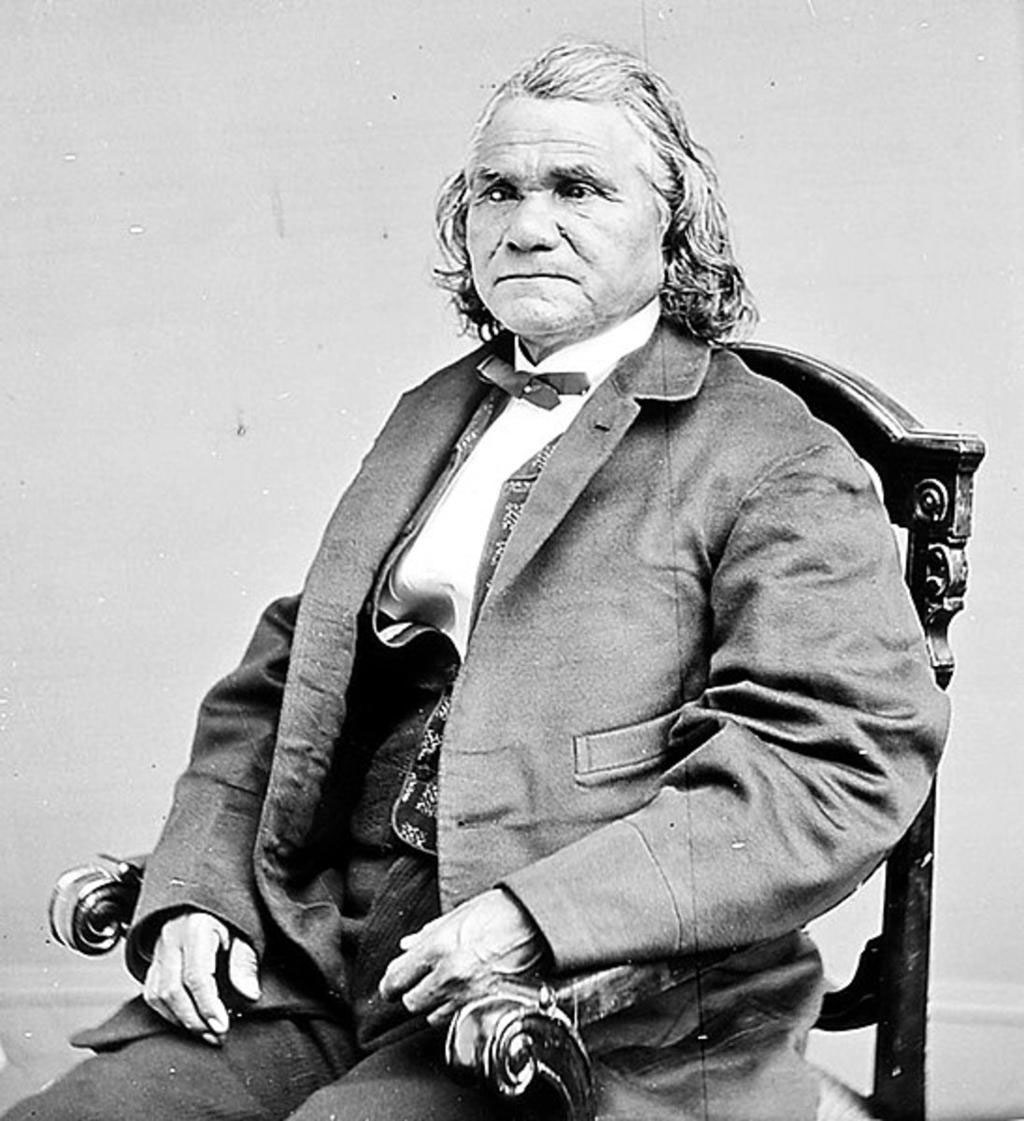
Stand Watie
1806–1871
A Cherokee political leader and Confederate brigadier general, Watie commanded Native forces during the Civil War and surrendered in June 1865, after the Confederacy’s principal armies had already capitulated.National Park Service historical account.
Stand Watie illustrates the political complexity of Native participation in the Confederacy.
He belonged to a prominent Cherokee family and had supported the controversial 1835 Treaty of New Echota, which facilitated the removal of the Cherokee people from their eastern homelands. That treaty divided Cherokee politics for years.
During the Civil War, Watie organized Confederate Cherokee troops, fought in numerous engagements, and ultimately commanded a brigade of Native soldiers.
His career provides a direct connection between Cherokee political divisions, Confederate military service, and the negotiations that followed the war.
Yet Watie’s allegiance was not the allegiance of every Cherokee.
Principal Chief John Ross initially sought neutrality. The Cherokee Nation entered a Confederate alliance in 1861, but Ross later aligned with the Union, and the nation became sharply divided.
The Cherokee National Council abolished slavery in February 1863, before the federal Reconstruction treaty of 1866.
That chronology matters.
The 1866 treaty did not introduce emancipation into a Cherokee society that had taken no prior action. Instead, it formalized and expanded obligations in the aftermath of an internal political struggle and a devastating war.
The same distinction must be maintained throughout the five nations. Their governments had different wartime experiences, and their subsequent treaty obligations were not identical.
Nevertheless, the broader consequence was unmistakable.
The Confederate defeat forced a renegotiation of the relationship between the United States and Native governments that had entered alliances with the rebellion.
And within those negotiations, the future of formerly enslaved African Americans became a federal treaty issue.
The Treaties That Followed the War
In 1866, the United States concluded separate treaties with the Seminole, Choctaw and Chickasaw, Creek, and Cherokee nations.
These agreements addressed far more than slavery.
They involved land cessions, political relationships, transportation rights, federal oversight, national finances, and the restoration of relations after wartime alliances.
But their Freedmen provisions established a distinct set of obligations.
The treaties prohibited slavery and addressed the legal status of formerly enslaved people and their descendants. Several provided rights comparable to those of native citizens, while the Choctaw–Chickasaw agreement established a conditional process through which Freedmen could receive citizenship rights and land.
The Department of the Interior emphasizes that no single uniform treaty rule applies to every Freedmen population.
That qualification is essential to understanding what was promised.
The treaties cannot responsibly be reduced to a single declaration that every Freedman received the same rights, acreage, or financial award.
Their provisions differed in wording, eligibility, implementation, and consequences.
What they shared was the recognition that emancipation created obligations extending beyond the formal abolition of slavery.
The newly freed population could not simply disappear from the political and economic order in which it had lived.
Its future status had to be addressed.
The Cherokee Promise: Rights Beyond Emancipation
Article IX of the Cherokee Treaty of July 19, 1866, contained one of the clearest declarations of Freedmen rights.
It recognized qualifying formerly enslaved people, certain free Black residents, and their descendants as entitled to the rights of native Cherokees.
The significance of that language was substantial.
It did not merely prohibit former slaveholders from reclaiming human property. It established a treaty-based relationship between eligible Freedmen and the Cherokee Nation.
The article also expressly prohibited compensation to former slaveowners for the people who had been emancipated.
That final provision deserves attention.
The treaty rejected the proposition that slaveholders should receive financial reimbursement for the loss of enslaved human beings.
But the treaty did not create a general monetary reparations payment to the people who had endured slavery.
Its principal Freedmen guarantee concerned rights and membership.
Other Cherokee treaty provisions created settlement arrangements, including land provisions associated with a designated district. These should not be confused with a universal promise of individually titled 160-acre farms to every Cherokee Freedman.
The distinction between citizenship, settlement eligibility, and individual property ownership would become increasingly important as federal policies transformed communal tribal landholding into individual allotments.
For Cherokee Freedmen, the central promise was that emancipation would be followed by legal belonging.
The meaning of that promise would later become the subject of prolonged litigation.
The Choctaw and Chickasaw Agreement: Forty Acres and $300,000
The joint Choctaw–Chickasaw Treaty of April 28, 1866, contained a particularly detailed arrangement involving land, citizenship, and money.
Article III provided that the two nations would cede the territory known as the Leased District to the United States for $300,000.
The money was to be held in trust at an interest rate of at least five percent while the nations considered legislation granting specified rights to qualifying Freedmen.
Those rights included citizenship privileges and suffrage, with important exclusions concerning existing national annuities, funds, and public lands.
The agreement also contemplated an allocation of 40 acres to each eligible Freedman and descendant under its specified conditions.
The land was to be selected after designated Native groups had made their selections.
If the required legislation was enacted, the nations could receive the purchase money, subject to deductions for eligible Freedmen who elected to leave. The treaty provided for a $100-per-person deduction associated with such relocation.
If the legislation was not enacted within two years, the treaty directed that the $300,000 instead be held for the benefit of qualifying Freedmen whom the United States would remove from the territory.
These provisions are sometimes described broadly as reparations.
That description requires care.
The $300,000 was not a direct unconditional compensation award to formerly enslaved people. It was consideration for a territorial cession, placed into a conditional trust arrangement involving Freedmen rights and relocation.
The 40-acre provision was a conditional land commitment, not an immediate grant of unrestricted ownership to every formerly enslaved person.
The $100 provision applied to a defined relocation arrangement, not to all Freedmen regardless of circumstances.
Even with those limitations, the treaty establishes something historically important: land and financial arrangements involving formerly enslaved African Americans were written directly into a ratified agreement between sovereign governments.
Article IV went further by addressing the practical conditions of freedom.
It recognized Freedmen’s ability to testify in legal proceedings, their right to fair compensation for labor, and protections against unequal treatment. It also provided for access to cultivable land under specified circumstances.
These were not merely symbolic declarations.
They concerned the economic means by which people emerging from slavery could support households, enter contracts, pursue legal remedies, and establish a degree of independence.
The question is how fully those protections were implemented.
That question cannot be answered simply by reading the treaty. It requires examining subsequent legislation, federal administration, claims, land records, and the experiences of Freedmen families.
The Creek Treaty: Compensation for Losses and an Interest in National Wealth
The Creek Treaty of June 14, 1866, contained provisions that went beyond emancipation and citizenship.
Article II extended the rights and privileges of native citizens to qualifying people of African descent and their descendants. Its language expressly included an equal interest in the nation’s soil and national funds.
This was a significant economic declaration.
It connected Freedmen not only to civic membership but also to the collective resources of the nation in which they lived.
Article III established a separate financial arrangement arising from the Creek Nation’s cession of approximately 3.25 million acres to the United States.
The federal government agreed to pay $975,168 for the ceded land, with the proceeds allocated among several purposes.
Of particular importance was a $100,000 provision for federal soldiers, loyal Native refugees, and Freedmen who had been driven from their homes by Confederate forces.
The treaty directed that compensation be based on their respective losses.
Article IV required officials to identify eligible individuals, investigate their losses, determine awards, and arrange payments.
This was not a universal reparations payment for slavery.
It was a treaty-based compensation mechanism for documented wartime losses, and formerly enslaved African Americans were explicitly among the eligible groups.
The distinction does not reduce its significance.
Unlike a general expression of sympathy or a political promise of future assistance, the treaty established an identifiable sum, a defined population of potential claimants, and an administrative process for determining compensation.
The existence of that mechanism raises historical accounting questions.
How many Freedmen submitted claims? How were their losses evaluated? What payments were authorized? How much was actually distributed, and to whom?
The treaty itself cannot answer those questions.
The answers would require examining federal claims records, Creek agency correspondence, payment registers, and Treasury documentation.
Nevertheless, the provision establishes that African American Freedmen were not merely incidental beneficiaries of the Reconstruction settlement.
They were expressly named within a financial compensation arrangement.
The Seminole Treaty: Citizenship in a Divided Nation
The Seminole Treaty of March 21, 1866, likewise abolished slavery and addressed the rights of people of African descent.
Article II acknowledged the presence of African-descended people who lacked recognized civil rights and property interests in the soil. It provided that eligible persons and their descendants would enjoy the rights of native citizens.
The agreement also contained land and financial provisions associated with the reorganization of Seminole territory and the restoration of the nation’s economic life.
The Seminole experience was distinctive.
Relationships between Seminole communities and African-descended populations had developed through a long history of refuge, military cooperation, intermarriage, community formation, and, in some circumstances, enslavement.
Black Seminoles had played important roles in military and political affairs well before the Civil War.
Their history cannot be reduced to the plantation model of slavery, although that does not eliminate the documented existence of enslavement within the nation.
For the Freedmen protected by the 1866 agreement, the central issue was the recognition of citizenship rights within a society whose political and social history already included African-descended communities.
As with the other treaties, the promise of equality would eventually encounter disputes over enrollment, membership, and access to government services.
When the Federal Government Began Classifying Ancestry
The next major transformation came decades after emancipation.
During the late nineteenth century, federal authorities sought to dismantle communal landholding systems within Native nations and distribute land through individual allotments.
The Dawes Commission, established in 1893, became a central instrument of that policy.
Its work involved determining who qualified for enrollment and, ultimately, who could receive land allotments.
The process produced extensive records, including applications, testimony, census cards, approved and rejected enrollment lists, and allotment files.
The National Archives maintains these materials today.
For African American Freedmen and their descendants, the enrollment system introduced a consequential administrative distinction.
Applicants could be classified on rolls identifying citizens by blood or on separate Freedmen rolls.
Those categories did not always correspond neatly to a person’s actual ancestry.
Some African-descended people had Native American parents or grandparents. Others belonged to families whose connections to Native nations extended across generations.
Yet federal classification practices could place such individuals within the Freedmen category rather than the by-blood category.
This distinction mattered because enrollment records became foundational documents for later determinations of citizenship and, in some circumstances, access to land and other benefits.
A person’s place within the administrative record could therefore shape the legal treatment of descendants who had never encountered the original enrollment officials.
The deeper issue was the transformation of political belonging into a bureaucratic classification.
The treaties had established rights for qualifying people and their descendants.
The later enrollment system required individuals to fit into categories constructed for federal administrative purposes.
Those categories were then carried forward into a future in which tribal citizenship, federal statutes, and documentary ancestry became increasingly intertwined.
The consequences would not be uniform across the five nations.
But the structural tension was unmistakable.
A system originally intended to determine eligibility for allotment could become a lasting instrument for distinguishing among descendants of people who had lived within the same Native nation.
The Five-Dollar Indian and the Question of Enrollment Fraud
The Dawes era also produced allegations that some people obtained Native enrollment through fraudulent claims.
Popular historical accounts sometimes describe the so-called Five-Dollar Indian: an individual, often portrayed as white, who supposedly secured recognition as Native American through a small payment or bribe.
The expression has become part of a broader discussion about race, ancestry, land, and the administration of Native identity.
But it requires careful treatment.
There was no general federal law allowing white Americans to purchase Native ancestry for five dollars.
Nor does the existence of white-presenting Native Americans establish fraudulent enrollment. Native communities had experienced generations of intermarriage, and physical appearance is not a reliable measure of ancestry or citizenship.
What the historical record does establish is that enrollment fraud and corruption were subjects of contemporary concern.
A National Archives study of the Dawes Commission describes allegations that earlier citizenship rolls contained inaccurate entries and names added through bribery or other improper practices. Congressional officials were aware of those concerns even as the federal government moved forward with the enrollment system.
The exact prevalence of five-dollar payments, however, cannot be established from the expression itself.
For an investigation centered on African American Freedmen, the more important question is not whether every popular account of enrollment fraud can be verified.
It is whether the government applied consistent standards when recognizing ancestry and determining eligibility.
Could a person of European and Native ancestry be recorded as a citizen by blood while a person of African and Native ancestry was assigned to a Freedmen roll?
Historical enrollment practices demonstrate that such classifications could occur.
But proving that a particular applicant obtained recognition fraudulently, or that another person lost a specific allotment because of that fraud, requires individual documentary evidence.
That distinction is essential.
The documented history of racial classification is substantial enough to examine without relying on unverified claims that every white-presenting enrollee acquired status improperly.
The more serious investigation concerns the relationship between the classification system, the rights established by treaty, and the property consequences that followed.
Land Was Not Simply a Benefit. It Was the Economic Foundation.
The transition from communal landholding to individual allotment was one of the most consequential federal interventions in Native economic life.
The Dawes Act of 1887 initially excluded the Five Tribes, but subsequent federal legislation and agreements extended allotment policies to their lands.
The stated objective was to replace collective ownership with individual property holdings.
In practice, the process facilitated the breakup of tribal land bases, exposed individual allotments to outside acquisition, and weakened traditional political and economic institutions.
The National Archives describes how federal officials pursued allotment despite significant Native resistance.
For Freedmen, land carried an additional meaning.
People emerging from slavery had spent generations producing economic value under conditions in which the fruits of their labor belonged to others.
Access to land offered the possibility of household independence, agricultural production, inheritance, and the accumulation of family wealth.
The difference between being permitted to cultivate land and holding a secure, transferable property interest was therefore substantial.
A family might obtain access to acreage yet remain vulnerable to legal restrictions, debt, fraudulent transactions, or outside acquisition.
A land allotment might represent a significant asset at the moment of distribution but fail to produce lasting wealth if the owner could not retain it.
And a descendant’s eligibility for particular rights might depend on the classification assigned to an ancestor decades earlier.
These circumstances reveal why the economic history of Freedmen cannot be measured simply by asking whether land was promised.
The relevant questions are broader.
What land was actually allotted? What title protections applied? How long did families retain ownership? Were allotments transferred voluntarily, lost through legal proceedings, or acquired through fraud? How did those outcomes compare with those of other enrolled citizens?
Answering these questions would require property-level research, not assumptions based solely on the treaty language.
The distinction matters because the loss of land was not confined to Freedmen.
Federal allotment policies caused extensive dispossession across Native communities.
Yet Freedmen faced the additional burden of racial classifications that could affect how their treaty-based rights were recognized.
The same federal system could undermine Native sovereignty while also producing unequal outcomes among the people it classified.
These were overlapping consequences of federal policy, not competing historical explanations.
The Treaty Promises Return to the Courts
For generations, the legal status of Freedmen descendants remained contested within several Native nations.
The disputes involved questions of treaty interpretation, constitutional authority, tribal sovereignty, and the legal meaning of citizenship.
Tribal governments possess inherent powers of self-government, including substantial authority over citizenship. Yet treaties with the United States can create binding obligations that limit how those powers are exercised.
The tension between those principles became especially visible in the Cherokee Nation.
In 2017, a federal district court ruled in Cherokee Nation v. Nash that qualifying Cherokee Freedmen descendants possessed treaty-based citizenship rights equivalent to those of native Cherokees.
The Cherokee Nation did not appeal.
In 2021, the Cherokee Nation Supreme Court held that constitutional language excluding Freedmen descendants through a by-blood requirement was incompatible with the 1866 treaty.
The Cherokee Nation subsequently secured federal approval of constitutional changes explicitly protecting Freedmen citizenship.
The Department of the Interior recognized those actions as fulfilling the Cherokee Nation’s treaty obligations concerning Freedmen citizenship.
This outcome is important because it demonstrates that treaty rights written during Reconstruction can remain legally consequential more than a century and a half later.
It also demonstrates that tribal sovereignty and Freedmen citizenship are not necessarily incompatible.
The Cherokee resolution was achieved through federal litigation, Cherokee judicial decisions, and constitutional action by the nation itself.
The Muscogee (Creek) Nation faced a related dispute.
In July 2025, its Supreme Court ruled that the Citizenship Board had acted contrary to the 1866 treaty when it denied applications by Freedmen descendants solely because their ancestors could not be traced to the Creek by-blood roll.
The court directed recognition of qualifying descendants appearing through either the Creek by-blood or Creek Freedmen rolls.
The legal ruling did not immediately settle the administrative dispute.
Subsequent proceedings concerned the implementation of citizenship documentation. In May 2026, the court closed the related enforcement case after declining additional requested relief, leaving the practical implementation of the ruling a matter requiring continued attention.
These developments illustrate the continuing importance of the Dawes classifications.
A federal enrollment decision made more than a century ago could remain central to determining whether a living descendant was recognized as a citizen.
The consequences were not confined to questions of identity or cultural affiliation.
Citizenship could also determine eligibility for political participation, tribal programs, and certain federal services.

The Federal Government’s 2026 Findings
The historical argument gained a contemporary documentary foundation when the Government Accountability Office publicly released its report, Tribal Programs: Information on Freedmen Descendants of the Five Tribes, in January 2026.
The report examined treaty obligations, citizenship decisions, federal benefits, and the treatment of Freedmen descendants under selected federal statutes.
Using demographic modeling based on 2022 data, the GAO estimated that the population of Freedmen descendants numbered in the hundreds of thousands.
Its estimates should not be confused with an official count of enrolled citizens or people legally eligible for compensation.
The report also found that some enrolled Freedmen descendants experienced difficulty obtaining federal services, including programs related to health care, housing, and education.
The GAO interviewed 19 enrolled descendants in the Cherokee and Seminole Nations, most of whom reported barriers to certain services. Those interviews identified problems but did not constitute a statistically representative survey of all Freedmen descendants.
The agency further documented differences in the treatment of enrolled Freedmen descendants under certain federal statutes involving land ownership and criminal jurisdiction.
The significance is not that the report established a universal denial of benefits.
It did not.
Its significance is that a federal oversight agency documented continuing legal and administrative distinctions affecting descendants of people whose rights had been addressed by the treaties of 1866.
The report also demonstrates why the Freedmen question cannot be treated exclusively as a historical grievance.
It involves living populations, contemporary governments, federal programs, and judicial decisions.
The Reconstruction settlement remains part of the legal architecture through which these questions are considered.
Reparations, Restitution, and the Unfinished Accounting
The word reparations carries substantial historical and political weight.
In the context of the 1866 treaties, it is important to distinguish among compensation for enslavement, reimbursement for wartime losses, land rights, citizenship guarantees, and interests in national funds.
The treaties did not establish a universal reparations program compensating every Freedman for the years spent in bondage.
But they did establish obligations that could have significant economic consequences.
The Creek treaty explicitly included Freedmen among potential recipients of compensation for wartime losses.
The Choctaw–Chickasaw treaty created a conditional $300,000 financial arrangement and contemplated 40-acre land allocations.
The Cherokee treaty established equal citizenship rights for qualifying Freedmen and descendants.
The Creek and Seminole treaties addressed membership and participation in national rights and resources.
These were different mechanisms, but they shared a common feature: they recognized that emancipation required a settlement of legal and economic relationships.
What remains to be established is the full accounting of their implementation.
A serious historical audit would examine the amounts appropriated, transferred, retained, and distributed; the land actually allotted; the names of recognized beneficiaries; and the reasons particular claims were accepted or rejected.
It would also investigate whether descendants lost property through documented fraud, discriminatory administration, or other legally identifiable actions.
Such an inquiry cannot begin with an assumption that every treaty obligation remains unpaid.
Nor can it assume that the absence of a contemporary payment program proves every historical obligation was satisfied.
The proper starting point is the documentary record.
Treaty language establishes the obligation. Administrative records reveal the government’s response. Financial records establish disbursements. Land records show transfers of property. Court decisions identify the rights that remain legally enforceable.
Together, those sources can distinguish historical injustice from an identifiable, unresolved legal claim.
That distinction is indispensable if the objective is accountability rather than rhetoric.

Two Histories of Dispossession, One Unfinished Reconstruction
The history of Native American Freedmen resists simple moral categories.
Native nations endured forced removal, territorial confiscation, federal interference, and policies designed to weaken or dismantle their sovereignty.
Within those nations, some citizens also held African Americans in slavery, while others opposed Confederate alliances, resisted enslavement, or fought for the Union.
The federal government subsequently negotiated treaties that addressed emancipation and citizenship, even as its broader policies continued to undermine Native landholding and political autonomy.
Later, the Dawes enrollment process converted complex histories of family, community, and belonging into administrative categories that would influence generations.
For African American Freedmen, those categories could become barriers between treaty-recognized rights and their practical exercise.
The history therefore cannot be reduced to a contest over which population suffered more.
It is a history of overlapping institutions, unequal power, and promises made within a political settlement that the United States helped construct.
Nor should the subject be understood as an argument that contemporary Native Americans collectively bear personal responsibility for the actions of nineteenth-century slaveholders.
The relevant questions concern historical institutions, the conduct of governments, the obligations of treaties, and the rights of people living today.
Those questions require the same evidentiary standards applied to any other investigation of slavery, property, citizenship, and public accountability.
The Confederate alliances explain part of the circumstances that produced the treaties.
The treaties explain the legal commitments made to Freedmen.
The Dawes records explain how subsequent federal classifications could influence the exercise of those rights.
And the court decisions and federal findings of the twenty-first century demonstrate that the consequences have not entirely disappeared.
In 1866, the United States and five Native nations confronted the end of slavery within their territories.
They negotiated agreements intended to settle relationships disrupted by war, emancipation, and political realignment.
For the formerly enslaved, those agreements offered different combinations of freedom, recognition, citizenship, land access, and economic protection.
A century and a half later, the historical record still invites an accounting of what those commitments meant in practice.
The essential question is no longer whether the promises existed.
They are preserved in ratified treaties, federal archives, and judicial opinions.
The question is whether the institutions responsible for carrying them forward delivered what was promised—and what the surviving records reveal about the people who did, and did not, receive it. Prove It
InnerKwest | Historical Investigation | October 2026 Primary documentary foundation: the ratified treaties of 1866; U.S. Department of the Interior testimony on the Five Tribes’ Reconstruction treaties; National Archives Dawes Commission records; Cherokee Nation constitutional and judicial history; Muscogee (Creek) Nation Supreme Court decisions; and GAO-26-107118, publicly released January 14, 2026.
At InnerKwest.com, we are committed to delivering impactful journalism, deep insights, and fearless social commentary. Your cryptocurrency contributions help us execute with excellence, ensuring we remain independent and continue to amplify voices that matter.
To help sustain our work and editorial independence, we would appreciate your support of any amount of the tokens listed below. Support independent journalism:
BTC: 3NM7AAdxxaJ7jUhZ2nyfgcheWkrquvCzRm
SOL: HxeMhsyDvdv9dqEoBPpFtR46iVfbjrAicBDDjtEvJp7n
ETH: 0x3ab8bdce82439a73ca808a160ef94623275b5c0a
XRP: rLHzPsX6oXkzU2qL12kHCH8G8cnZv1rBJh TAG – 1068637374
SUI – 0xb21b61330caaa90dedc68b866c48abbf5c61b84644c45beea6a424b54f162d0c
and through our Support Page.
InnerKwest maintains a revelatory and redemptive discipline, relentless in advancing parity across every category of the human experience.
© 2026 InnerKwest®. All Rights Reserved | Haki zote zimehifadhiwa | 版权所有. InnerKwest® is a registered trademark of Inputit™ Platforms Inc. Global. No part of this publication may be reproduced, distributed, or transmitted in any form or by any means without prior written permission. Unauthorized use is strictly prohibited. Thank you for standing with us in pursuit of truth and progress!