
May 25, 2026
Project 2025 is publicly framed as administrative reform and constitutional restoration. Critics increasingly argue it represents the operational phase of a decades-long institutional strategy designed to reshape federal authority, civic enforcement, and democratic oversight in the United States.
By Intelligence Desk
The Heritage Foundation did not suddenly arrive at Project 2025.
That is the first reality missing from much of the national discussion.
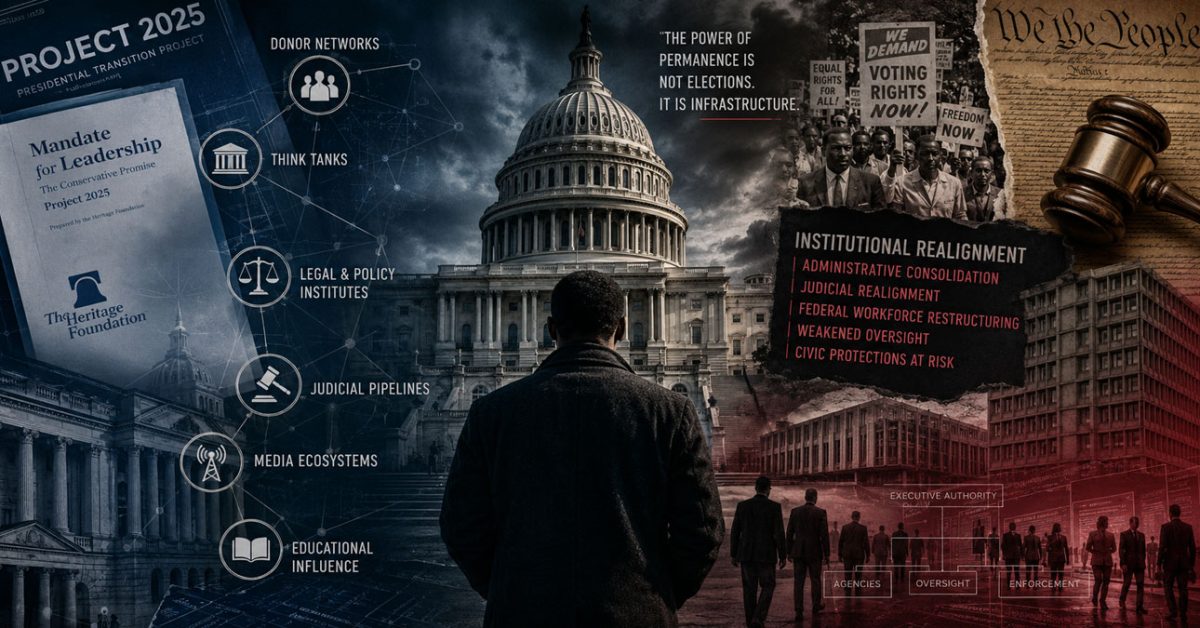
The framework now dominating political headlines is frequently discussed as though it were simply another election-cycle policy agenda attached to conservative governance priorities. Critics increasingly argue it is something much larger: the visible maturation of an institutional infrastructure developed quietly over decades through think tanks, donor networks, judicial pipelines, media ecosystems, legal organizations, and policy institutes specifically designed for long-term influence over American governance.
The issue is no longer merely electoral politics.
The issue is institutional continuity.
Project 2025 is publicly framed as:
- constitutional restoration,
- executive branch reform,
- administrative efficiency,
- and anti-bureaucratic governance.
Critics increasingly argue it represents:
- institutional consolidation,
- judicial recalibration,
- federal workforce restructuring,
- weakened oversight mechanisms,
- and the gradual contraction of post-Civil Rights civic protections.
That distinction defines the modern debate.
Because communities rarely experience ideology through mission statements.
They experience it through consequence.
Kevin Roberts now sits near the center of that collision. The current Heritage Foundation president is not simply a conservative strategist or political executive. He is also a historian whose graduate scholarship focused heavily on African-American kinship systems under slavery. His work examined how enslaved Black families preserved continuity, communal identity, and extended kinship structures despite institutional systems deliberately designed to fracture them.
That historical detail changes the gravity of the conversation surrounding him.
Roberts did not casually study African-American history. He immersed himself in one of its most intimate dimensions:
- institutional fragmentation,
- forced instability,
- communal disruption,
- and survival under systems of organized power.
Decades later, Roberts would emerge as one of the leading public figures associated with Project 2025 — a governing framework critics increasingly believe threatens many of the institutional protections upon which modern African-American civic and economic advancement depended after the Civil Rights era.
The contradiction is impossible to ignore.
The question is no longer whether critics can conclusively prove private intent. The deeper issue is whether repeated structural outcomes eventually become more politically significant than stated motivations.
Systems reveal themselves through repetition.
The Long Institutional Strategy
The modern Heritage Foundation infrastructure emerged during one of the most unstable transitional periods in modern American history. The aftermath of the Civil Rights Movement, Vietnam, Watergate, judicial expansion, urban unrest, and the growth of federal social programs permanently altered the relationship between the American government and its citizens.
Conservative institutional planners recognized something critical during that period:
elections alone were insufficient.
Permanent infrastructure was required.
That infrastructure expanded steadily over decades through donor-backed continuity systems connected to organizations and funding networks associated with:
- Joseph Coors,
- the Scaife Foundations,
- the Bradley Foundation,
- DonorsTrust,
- and broader conservative institutional ecosystems.
Think tanks became policy laboratories.
Legal organizations became judicial pipelines.
Donor-advised funds became continuity engines.
Media ecosystems became narrative reinforcement structures.
Educational influence became ideological infrastructure.
Project 2025 did not suddenly appear.
Critics increasingly argue it represents the operational maturation of that long-built architecture.
This is why many observers no longer interpret the document itself as the primary story. The real story is the continuity structure behind it — the ability to shape governance across generations regardless of which political personalities temporarily occupy office.
History does not require unanimous public support to produce enduring structural change. It only requires sufficiently organized networks possessing:
- institutional access,
- financial infrastructure,
- ideological continuity,
- judicial influence,
- media reinforcement,
- and long-term strategic patience.
That is the real power of permanence.
Not elections.
Infrastructure.
The Civic Re-calibration Debate
For many African Americans, the concern surrounding Project 2025 is not abstract.
It is historical.
Post-Civil Rights African-American advancement was deeply connected to:
- federal enforcement systems,
- voting-rights protections,
- affirmative action frameworks,
- public-sector employment,
- educational access,
- labor protections,
- and administrative oversight mechanisms created during and after the Civil Rights era.
Entire segments of the modern Black middle class emerged through institutional openings created by federal intervention.
That reality is measurable.
Critics increasingly argue many contemporary restructuring efforts now converge around weakening those systems simultaneously.
The current debates involve:
- federal workforce reduction,
- DEI rollbacks,
- judicial reinterpretation of affirmative action,
- voting-rights litigation,
- redistricting battles,
- educational restructuring,
- administrative consolidation,
- and expanded executive authority over federal agencies.
Viewed individually, supporters frame many of these developments as:
- constitutional correction,
- anti-bureaucratic reform,
- fiscal discipline,
- or opposition to government overreach.
Viewed collectively, many critics increasingly see institutional recalibration.
The language changes every generation.
The structural direction often does not.
American history contains recurring cycles of civic expansion followed by institutional contraction. Reconstruction was followed by Jim Crow. Voting expansion was followed by suppression frameworks. Urban renewal frequently produced Black displacement under the language of modernization. Redlining reshaped generational wealth accumulation. Mass incarceration reorganized entire communities through legal and administrative systems operating under the banner of law and order.
The mechanisms evolve.
The outcomes often feel familiar.
This is why many critics reject the argument that Project 2025 is simply another conservative policy proposal. They increasingly view it as part of a much older institutional struggle over:
- federal authority,
- civic enforcement,
- judicial interpretation,
- and democratic access itself.
Administrative restructuring often produces social restructuring downstream.
That historical reality is difficult to ignore.
The Legitimacy Question
The deeper concern now extends beyond ordinary partisan disagreement.
It is legitimacy.
Richard Nixon resigned because institutional pressure collapsed around him. Republican allies withdrew support. Media fragmentation remained limited. There was still broad bipartisan belief that preserving institutional legitimacy mattered more than preserving any single administration.
Critics increasingly argue those standards have eroded.
The issue now is not merely corruption.
It is normalization.
Conduct once considered politically disqualifying increasingly becomes absorbed into:
- partisan identity systems,
- ideological media ecosystems,
- institutional loyalty structures,
- and narrative reinforcement networks capable of insulating political actors from traditional accountability pressures.
Democracies rarely collapse through singular dramatic events.
They erode through normalized exceptions.
That fear is not confined to the United States. South Africa’s ongoing Madlanga Commission investigations have exposed similar anxieties surrounding institutional legitimacy. The concern there extends beyond isolated corruption allegations toward fears that portions of:
- law enforcement,
- procurement systems,
- political networks,
- intelligence structures,
- and organized criminal elements
may have become sufficiently intertwined to weaken public confidence in the neutrality of the state itself.
Once populations begin questioning whether accountability mechanisms apply equally across institutions and classes of power, legitimacy itself begins deteriorating.
That deterioration is gradual.
Not theatrical.
Institutions rarely dismantle themselves through dramatic announcement. More often the shift occurs through administrative decisions, legal reinterpretations, personnel restructuring, narrative normalization, and the slow recalibration of public expectation until the cumulative direction becomes impossible to ignore.

The Historical Memory Beneath the Debate
Perhaps the greatest misunderstanding surrounding Project 2025 is the assumption that critics are reacting emotionally to ordinary partisan disagreement. For many African Americans, the concern is far deeper than party politics because the historical memory beneath the debate is not abstract. It is inherited.
African Americans occupy a historically distinct position within the global African diaspora:
- culturally influential,
- globally recognizable,
- yet shaped by slavery,
- forced assimilation,
- ancestral fragmentation,
- and generations of institutional instability unlike most immigrant populations in the United States.
That historical condition produces heightened sensitivity to civic recalibration because history repeatedly demonstrated how quickly institutional protection can become institutional vulnerability once political systems are reorganized. Communities that survived slavery, Reconstruction collapse, segregation, redlining, voter suppression, urban displacement, and mass incarceration do not interpret administrative restructuring the same way populations untouched by those historical realities might.
This is why many critics increasingly argue the outcomes themselves have become more important than stated intentions.
Not because every participant within the conservative institutional ecosystem shares identical motives. Not because every policy debate operates through explicit racial language. And not because every restructuring proposal automatically produces identical consequences. The concern emerges from cumulative direction — the repeated convergence of structural outcomes around the weakening of systems historically tied to African-American civic and economic protection.
Communities do not experience governance through white papers or think tank language. They experience it through:
- employment access,
- educational opportunity,
- voting protections,
- judicial enforcement,
- economic mobility,
- neighborhood stability,
- and the ability to transfer security across generations.
That is why the debate surrounding Project 2025 increasingly extends beyond ordinary policy disagreement. Critics are not merely reacting to isolated proposals. They are responding to what they believe is a broader institutional trajectory involving:
- administrative consolidation,
- judicial realignment,
- weakened oversight structures,
- federal workforce restructuring,
- and the gradual recalibration of post-Civil Rights governance itself.
Whether supporters view those changes as necessary reform or critics view them as civic contraction is now secondary to a larger reality: the restructuring debate is no longer theoretical. The administrative blueprint is public. The donor infrastructure behind it is visible. The judicial alignment surrounding it is measurable.
And for many observers, the cumulative direction no longer feels disconnected.
It feels historical.
At InnerKwest.com, we are committed to delivering impactful journalism, deep insights, and fearless social commentary. Your cryptocurrency contributions help us execute with excellence, ensuring we remain independent and continue to amplify voices that matter.
To help sustain our work and editorial independence, we would appreciate your support of any amount of the tokens listed below. Support independent journalism:
BTC: 3NM7AAdxxaJ7jUhZ2nyfgcheWkrquvCzRm
SOL: HxeMhsyDvdv9dqEoBPpFtR46iVfbjrAicBDDjtEvJp7n
ETH: 0x3ab8bdce82439a73ca808a160ef94623275b5c0a
XRP: rLHzPsX6oXkzU2qL12kHCH8G8cnZv1rBJh TAG – 1068637374
SUI – 0xb21b61330caaa90dedc68b866c48abbf5c61b84644c45beea6a424b54f162d0c
and through our Support Page.
InnerKwest maintains a revelatory and redemptive discipline, relentless in advancing parity across every category of the human experience.
© 2026 InnerKwest®. All Rights Reserved | Haki zote zimehifadhiwa | 版权所有. InnerKwest® is a registered trademark of Inputit™ Platforms Inc. Global. No part of this publication may be reproduced, distributed, or transmitted in any form or by any means without prior written permission. Unauthorized use is strictly prohibited. Thank you for standing with us in pursuit of truth and progress!