
August 25, 2026
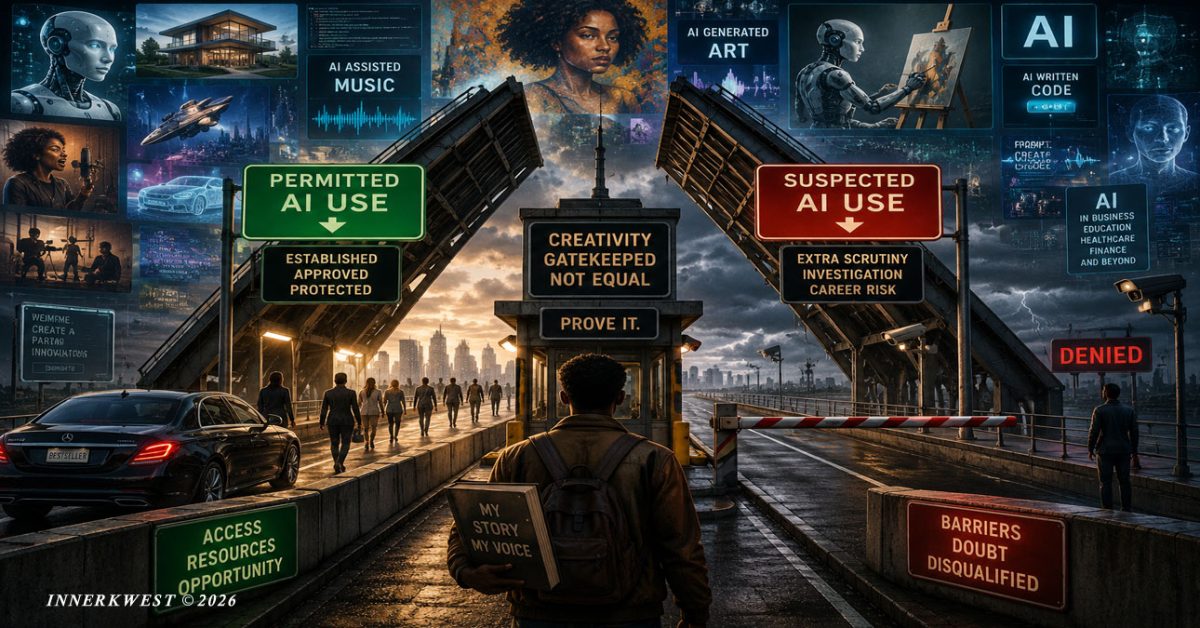
A Black novelist can lose a multimillion-dollar opportunity over suspected AI use while other writers openly acknowledge using the same technology. In a society already allowing artificial intelligence to transform music, film, employment and everyday life, the emerging question is no longer whether AI is coming. It is who gets permission to use it.
By InnerKwest Editorial Desk
Jerry Falade had already passed one of the hardest tests in publishing.
People wanted to read his book.
His debut crime novel, Call Me, I’ll Hide the Body, generated intense publishing interest, including a 14-way auction and an offer reportedly reaching $2 million. Publishing professionals had read the manuscript. Agents believed in it. Editors competed for it. According to an email later reported by The Independent, the manuscript had “dazzled us and the top publishing professionals around the world.”
Then the question changed.
It was no longer whether the book was good.
It was whether Falade had used artificial intelligence to create it.
Falade, a Nigerian writer and PhD student in Texas, has denied using AI to write the manuscript. He has acknowledged using ChatGPT for research, including questions involving details needed for his crime story and differences between British and American terminology. His agents ultimately withdrew the manuscript after concerns arose about AI involvement and they said they could no longer verify its provenance.
Consider what happened.
The story did not change.
The characters did not change.
The sentences that had attracted publishers did not suddenly rearrange themselves.
What changed was the institutional perception of how the product may have been produced.
That distinction deserves considerably more attention than it is receiving.
Because Jerry Falade’s story is arriving at exactly the moment when artificial intelligence is becoming embedded throughout modern economic and creative production. Companies are deploying AI to write software, analyze financial information, produce advertising, automate customer service, generate images, assist filmmaking, create music, screen information and perform portions of jobs previously assigned exclusively to human beings.
Society may argue about whether those developments are desirable. But arguing about them does not make their effects disappear.
AI is here.
So perhaps the more useful question is no longer whether artificial intelligence should participate in human production.
It already does.
The more uncomfortable question is:
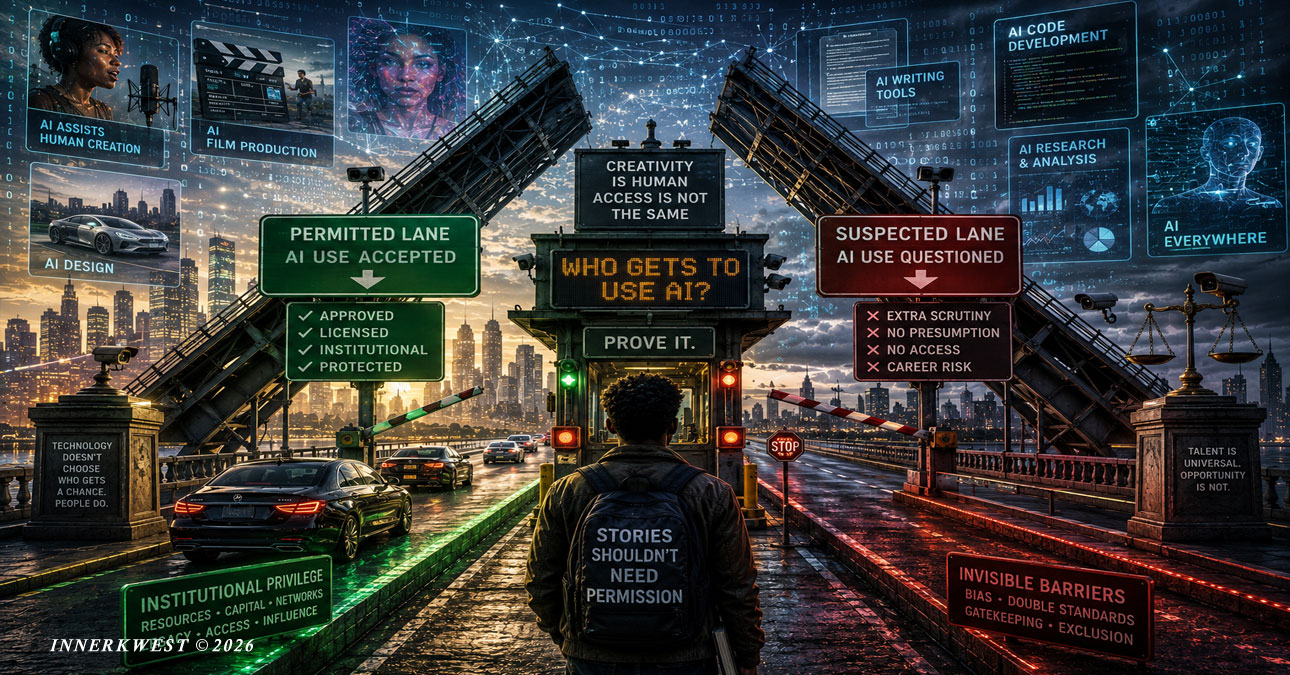
Who gets to use it?
When Suspicion Becomes a Gate
Falade argues that race cannot be separated from what happened to him.
That allegation should not be casually dismissed, particularly because his case does not stand alone.
The Independent identified three Black writers whose major opportunities were disrupted during 2026 following AI suspicions: Falade, Mia Ballard and Jamir Nazir. Ballard’s horror debut Shy Girl was cancelled by Hachette after questions arose about AI-detected passages. Nazir’s Commonwealth Short Story Prize-winning work faced AI allegations; the Commonwealth Foundation subsequently conducted a review and cleared him, yet Granta maintained its decision to sever ties with the prize. The publication also discussed HM Wolfe’s Daggermouth, which encountered allegations that portions of the work were machine-generated.
That pattern becomes more difficult to ignore when compared with writers who openly discuss AI.
Stephen Marche wrote plainly in The Guardian this year that he had written a novel using AI and argued that writers must learn to live and work with artificial intelligence. His AI-assisted Death of an Author appeared in 2023. He remains an active author and commentator.
Bestselling novelist Anthony Horowitz has publicly described using ChatGPT regularly for research. Nobel laureate Olga Tokarczuk has discussed using AI in connection with character research and development, later clarifying the limits of that use.
And this is hardly fringe behavior.
A 2025 BookBub survey of 1,229 authors found that approximately 45 percent were already using generative AI to assist their work. Among those using it, applications ranged from research and editing to outlining, plotting, marketing and writing assistance. Seventy-four percent of AI-using respondents said they did not disclose that use to readers.
So AI use itself cannot credibly be presented as an automatic disqualification from contemporary authorship.
It plainly isn’t.
The question becomes why admitted AI use can coexist with continuing literary careers while suspected AI use can help destroy extraordinary opportunities for others.
And when several of the writers suffering the most severe consequences are Black, race cannot simply be escorted out of the room because discussing it makes the conversation uncomfortable.
The disparity is observable.
The consequences are measurable.
The burden is therefore on the institutions applying the standards to demonstrate that comparable conduct receives comparable treatment.
The Detector Has Its Own Problem
There is another difficulty.
The technology increasingly being asked to help determine whether humans used technology is itself unreliable.
Stanford researchers examining seven widely used GPT detectors tested 91 TOEFL essays written by non-native English writers. The average false-positive rate was approximately 61 percent. Nearly one in five of the human-written essays was unanimously classified as AI-generated by all seven detectors, while at least one detector flagged almost 98 percent of them. The researchers warned that such systems could disproportionately penalize non-native English writers.
That finding has enormous implications beyond Jerry Falade.
It means the emerging AI-authenticity gate may not merely be subjective.
The instrument guarding the gate can itself produce unequal results.
This is particularly consequential in a global publishing market where writers increasingly emerge from Africa, Asia, the Caribbean and other regions where English may be a second or third language.
A technology capable of disproportionately misidentifying their human writing as machine-generated cannot simply be inserted into institutional decision-making and treated as neutral evidence.
And yet the larger problem goes beyond detectors.
Publishing appears to be developing something resembling a technological purity test at precisely the moment when technological purity is disappearing almost everywhere else.
The Consumer Never Asked for a Purity Test
There is an assumption buried underneath much of the controversy surrounding AI-generated entertainment: that audiences require knowledge of how every element of creative work was produced before they can legitimately experience it.
But do they?
A reader encounters a novel.
The story captures the imagination or it doesn’t.
Characters become memorable or they don’t.
The reader laughs, becomes angry, feels suspense, loses interest, finishes the book or puts it down.
Then the reader continues through life.
That transaction is particularly important when discussing fiction.
Fiction is invention by definition.
The purpose of a crime novel is not to establish that every event described actually happened. Its principal obligation as entertainment is to create an experience compelling enough for someone to continue reading.
Plagiarism remains plagiarism.
Copyright infringement remains copyright infringement.
Contractual deception remains a legitimate contractual issue.
Those are identifiable forms of conduct and should be treated as such.
But the mere involvement of artificial intelligence is not synonymous with any of them.
And increasingly, even the people creating books seem to understand the distinction. One respondent in BookBub’s author survey summarized the matter more simply: readers principally want a good story.
That should not be surprising.
Consumers already encounter technological mediation throughout entertainment.
Digital music production can involve software at almost every stage. Movies contain digitally created environments, altered performances, synthetic effects and increasingly AI-assisted production tools. Images can be generated from detailed textual direction. Animation is undergoing its own technological transformation.
The audience generally consumes the finished product.
It experiences something.
It internalizes a response.
Then it moves on.
That does not mean creativity disappeared.
It may mean that some creativity moved.
A person capable of giving an image generator a generic instruction will generally receive a generic image. Someone capable of imagining composition, perspective, symbolism, lighting, emotional tone, historical context, wardrobe, environment and narrative purpose can direct the same technology toward an entirely different result.
The machine expands capability.
It does not magically provide imagination to someone who has none.
Yet even that may ultimately matter more to creators than consumers. Most viewers will never stop to ask who possessed the imagination to prompt a particular image.
They will look at it.
Feel something.
And continue scrolling.
Artificial Intelligence Is Apparently Acceptable When It Takes the Job
This makes the purity argument even harder to sustain.
Workers across the economy are already being asked to accept artificial intelligence when corporations deploy it to increase productivity, reduce labor requirements or automate portions of human employment.
AI can participate in customer service.
AI can assist programmers.
AI can analyze documents previously assigned to junior professionals.
Robots can increasingly perform physical tasks associated with human labor.
Tesla’s retro-futuristic Hollywood diner has even used the company’s Optimus humanoid robot to serve popcorn as part of the customer experience.
Society did not stop.
Consumers did not collectively declare that hamburgers, movies, banking, software and transportation must remain technologically pure.
The economy continued moving.
So there is something peculiar about telling an individual creator that the productivity multiplier being normalized throughout corporate America becomes culturally suspicious when placed in that creator’s hands.
A corporation may use AI to reduce its dependence upon workers and call it efficiency.
An individual may use AI to reduce dependence upon expensive production infrastructure and encounter questions about legitimacy.
Those are not necessarily equivalent circumstances.
But the difference deserves explanation.
Because democratizing technology frequently produces a familiar institutional response.
The first gate falls.
Another appears farther down the road.
We Have Seen This Movie Before
The pattern is not unique to publishing.
Decentralized finance and Web3 promised to reduce traditional barriers to financial innovation. Developers could build financial infrastructure without first becoming banks. Entrepreneurs could launch global projects without obtaining permission from traditional financial intermediaries.
Then other gates became increasingly important: banking access, venture backing, exchange listings, jurisdiction, regulatory classifications, institutional custody, liquidity relationships and access to established capital.
Technology opened one door while institutional legitimacy constructed another.
Artificial intelligence may now be doing something similar to creative production.
A person who previously needed substantial financial resources to access researchers, editors, designers, illustrators, musicians, production studios or technical specialists can increasingly command portions of those capabilities directly.
That is democratization.
And democratization becomes much more disruptive when the technology doesn’t merely make established institutions more efficient.
It makes outsiders more capable.
Music Has Already Exposed the Permission Question
The dispute surrounding AI music platform Suno provides an illuminating example.
The music industry initially fought Suno over allegations involving copyrighted recordings and compositions. Yet in November 2025, Warner Music Group and Suno announced a partnership that settled their litigation and established a framework for new AI models trained using licensed music. Participating Warner artists and songwriters can opt into uses involving their names, voices, likenesses and compositions and receive new revenue opportunities.
Warner has been remarkably clear about its position: AI partnerships should involve licensed models, economic recognition of music’s value and artist choice. Its AI arrangements now include companies such as Suno, Udio, Klay and Stability AI.
There are legitimate copyright and compensation questions embedded in that position.
But there is also something revealing.
Once an institutional licensing structure exists, AI-generated music becomes commercially acceptable.
The machine did not suddenly become human.
The mathematical principles underlying generative technology did not become morally purified.
Permission changed.
And music exposes another problem with the concept of absolute creative originality.
Musicians do not develop in isolation.
A pianist has heard other pianists. A guitarist has absorbed other guitarists. Producers have listened to decades of recorded music. Composers learn scales, harmonic structures, rhythmic relationships and forms inherited from musicians who lived centuries before them.
Beethoven influenced musicians who influenced musicians who influenced musicians.
The Beatles absorbed earlier musical traditions and became influences themselves.
Michael Jackson emerged from musical traditions that preceded him and subsequently influenced generations that followed.
Human creativity has always involved absorption, memory, recombination, interpretation and transformation.
Generative AI dramatically changes the scale and mechanics of that process. Copyright law must address those differences.
But hiring humans, licensing catalogs or constructing approved datasets cannot create a culturally sterile source of musical imagination.
There is no such source.
The human musician brought into the room has already been trained by a lifetime of listening.

Perhaps This Was Never About Purity
This is where the Jerry Falade controversy becomes larger than Jerry Falade.
If society had genuinely decided that artificial intelligence represents a moral contamination of human activity, we would be discussing a civilization-wide pause.
We aren’t.
AI is entering workplaces.
AI is entering entertainment.
AI is entering financial systems.
AI is entering transportation.
AI is entering music.
AI is entering publishing.
The argument therefore cannot seriously rest upon some macro societal commitment to technological purity.
There isn’t one.
What exists instead are boundaries determining where AI is accepted, where it is contested, who may deploy it, under what conditions and whose permission transforms controversial technology into legitimate commerce.
That is an institutional-power question.
And when the consequences of those boundaries repeatedly fall heavily upon Black creators, it becomes a racial question as well.
Not because every controversy involving a Black writer must automatically be attributed to racism.
But because race cannot be dismissed when comparable behavior appears capable of producing materially different outcomes.
Jerry Falade says he did not use AI to write his novel.
That matters.
But there is an uncomfortable possibility buried beneath his defense:
What if he had?
Suppose artificial intelligence helped him construct portions of a fictional story that publishing professionals nevertheless found extraordinary.
Suppose readers eventually loved it.
What precisely would have been corrupted?
The entertainment?
The reader’s emotional response?
The market value that publishers themselves had already assigned to the manuscript?
Or an institutional definition of who is allowed to call themselves a writer?
Those questions become considerably more important as creative technology becomes accessible to people who historically lacked access to the infrastructure surrounding cultural production.
Perhaps artificial intelligence did not create modern literary gatekeeping.
Perhaps it has simply made the gate easier to see.
And if the publishing industry maintains that race has nothing to do with who receives heightened scrutiny, there is a straightforward way to establish that.
Show the standards.
Show how they are applied.
Show the comparable cases.
Show what constitutes permissible AI assistance.
Show what constitutes impermissible AI authorship.
Show that acknowledged use by established writers is evaluated according to the same principles applied to emerging writers.
Show that a Nigerian writer, a Black American writer, a Nobel laureate and a bestselling white novelist approach the same gate under the same rules.
And if the argument is that these extraordinary interventions are ultimately necessary to protect readers, show us that readers demanded them.
The burden should not belong exclusively to the person standing outside the gate.
It belongs to the institution guarding it.
At InnerKwest.com, we are committed to delivering impactful journalism, deep insights, and fearless social commentary. Your cryptocurrency contributions help us execute with excellence, ensuring we remain independent and continue to amplify voices that matter.
To help sustain our work and editorial independence, we would appreciate your support of any amount of the tokens listed below. Support independent journalism:
BTC: 3NM7AAdxxaJ7jUhZ2nyfgcheWkrquvCzRm
SOL: HxeMhsyDvdv9dqEoBPpFtR46iVfbjrAicBDDjtEvJp7n
ETH: 0x3ab8bdce82439a73ca808a160ef94623275b5c0a
XRP: rLHzPsX6oXkzU2qL12kHCH8G8cnZv1rBJh TAG – 1068637374
SUI – 0xb21b61330caaa90dedc68b866c48abbf5c61b84644c45beea6a424b54f162d0c
and through our Support Page.
InnerKwest maintains a revelatory and redemptive discipline, relentless in advancing parity across every category of the human experience.
© 2026 InnerKwest®. All Rights Reserved | Haki zote zimehifadhiwa | 版权所有. InnerKwest® is a registered trademark of Inputit™ Platforms Inc. Global. No part of this publication may be reproduced, distributed, or transmitted in any form or by any means without prior written permission. Unauthorized use is strictly prohibited. Thank you for standing with us in pursuit of truth and progress!