
August 25, 2026
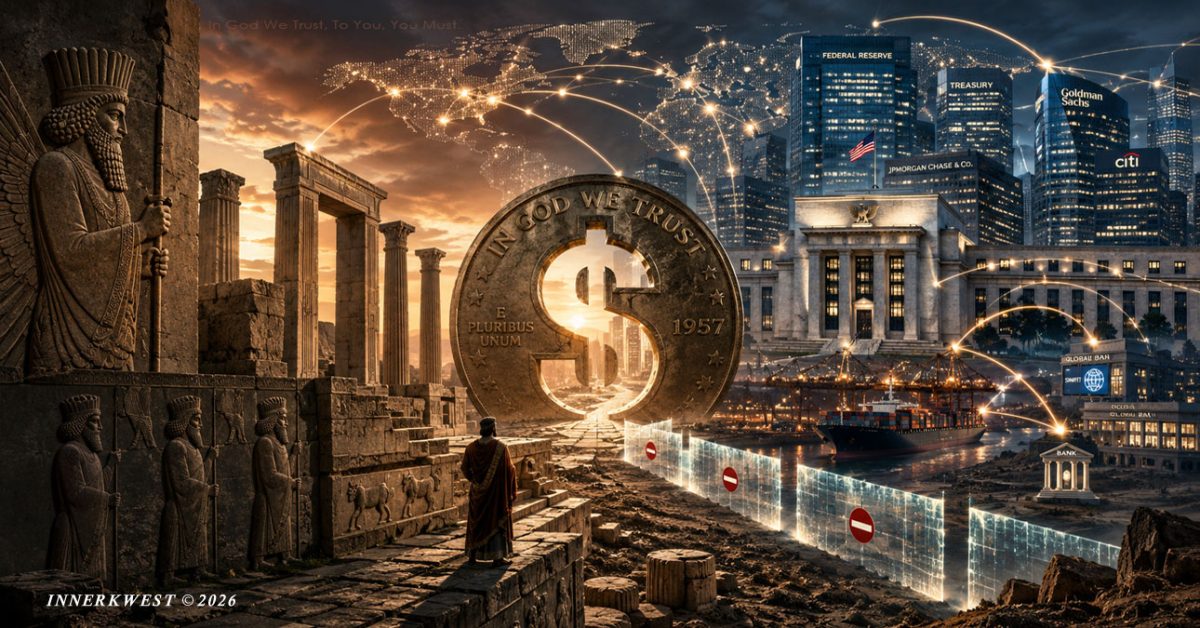
The United States is not a theocracy, yet its political culture repeatedly invokes God, scripture and Christian moral authority. Now Washington is threatening countries that continue doing business with Iran with possible exclusion from the dollar-based financial system. That raises a question extending far beyond sanctions or Persia: when control over the world’s dominant currency becomes a means of compelling sovereign nations to conform to American policy, where does economic statecraft end and the imposition of financial will begin?
By the InnerKwest Editorial Desk
There is a question America rarely asks about itself because asking it requires several conversations that modern institutions prefer to keep separated.
Religion belongs over here.
Economics belongs over there.
Foreign policy has another room.
Constitutional government occupies another.
And discussions of witchcraft, demonic influence or spiritual power are generally removed from respectable economic discourse altogether.
But what happens when the walls separating those rooms are taken down?
The United States has never constitutionally declared itself a Christian nation. It is not a theocracy. The First Amendment prohibits Congress from establishing religion, and Article VI of the Constitution explicitly declares that no religious test may be required for federal public office.
Yet anyone observing American public life would have difficulty arguing that religious language is absent from the country’s national identity.
“In God We Trust” appears on American currency. It was required on all U.S. currency by federal law in 1955 and began appearing on paper currency with the 1957 series of $1 silver certificates. Presidents invoke God. Congressional proceedings include prayer. Biblical passages, biblical personalities and Christian concepts regularly enter American political discourse.
America therefore occupies an unusual space.
It rejects theocracy constitutionally while frequently invoking religious symbolism culturally and politically.
That distinction matters.
Because once a society voluntarily introduces biblical morality into its description of itself, it becomes difficult to insist that biblical principles may only be consulted when they affirm the society’s behavior.
The Book cannot merely bless the throne.
The Book must also be permitted to question it.
And that brings us to Iran, ancient Persia, the American dollar—and an uncomfortable question about the nature of power.
Operation Economic Outcast
On August 24, 2026, the U.S. Treasury Department announced Operation Economic Outcast, describing it as an unprecedented economic campaign against the Islamic Republic of Iran and those enabling it.
Treasury Secretary Scott Bessent made the underlying proposition remarkably clear: governments, financial institutions and companies around the world would increasingly face a choice between maintaining economic relationships with Iran and maintaining access to the American financial system.
That distinction is essential.
This is no longer simply:
We will not trade with Iran.
Nor merely:
American companies may not conduct certain transactions with Iran.
The much larger proposition is:
If you conduct certain business with Iran, your access to us may also be placed at risk.
Reuters reported the practical implication directly: countries could be required to sever business ties with Iran or risk being pushed out of the dollar-based financial system. The administration has not yet deployed every threatened measure, and some potentially consequential foreign institutions have so far escaped the harshest sanctions.
That qualification matters.
InnerKwest should not report a threat as though every threatened sanction has already been imposed.
But neither should anyone minimize what has actually been announced.
The United States is openly placing the extraordinary reach of its financial architecture behind an attempt to influence economic relationships occurring far outside its territorial borders.
And that is where this discussion becomes larger than Iran.
What Exactly Is Being Exercised?
Strip away politics for a moment.
Strip away whether one supports or opposes the Iranian government.
Strip away Donald Trump.
Strip away Republicans and Democrats.
Strip away even the word sanctions.
What remains?
Will.
One government has determined that another government should be economically isolated.
It possesses sufficient control and influence over infrastructure used by other governments and private institutions to make noncompliance extraordinarily expensive.
It then tells third parties:
You remain free to choose.
But one choice may cost you access to something upon which much of international commerce depends.
Technically, choice remains.
Functionally, enormous coercive pressure has been introduced into that choice.
This is the point at which theology unexpectedly becomes relevant.
The Witchcraft Question
For readers encountering the word witchcraft in an economic article, precision is necessary.
This article is not alleging that the U.S. Treasury practices literal witchcraft.
It is not alleging that sanctions are supernatural.
It is not asking artificial intelligence, economists, politicians or secular institutions to determine whether demons, witchcraft or other supernatural forces exist.
Those are matters of religious belief, theology and conscience.
The question is considerably more disciplined.
Within strands of Christian teaching, witchcraft has historically been understood not only through imagery involving spells, rituals or occult objects, but also through concepts involving manipulation, domination, rebellion and attempts to impose one’s will upon people or circumstances through prohibited means.
Whatever a reader ultimately believes about that theological interpretation, it creates a provocative analytical framework:
Can a society repeatedly invoke a religious moral system while exempting its own exercise of power from examination under that system?
If attempting to dominate another’s will is spiritually suspect when performed by an individual, what changes when domination is institutionalized?
Scale?
Legality?
A flag?
A Treasury Department?
Or does the moral question survive the transition from individual power to state power?
That is not an accusation.
It is a question.
And serious questions should not become forbidden simply because their implications make powerful institutions uncomfortable.
Persuasion Is Not Compulsion
Christianity places enormous significance on human choice.
The biblical narrative repeatedly presents people with choices between obedience and disobedience, righteousness and unrighteousness, wisdom and foolishness.
Christian evangelism itself is fundamentally an appeal.
Believe.
Choose.
Follow.
Repent.
Those commands may carry theological consequences, but the distinction between persuasion and earthly compulsion remains significant.
That makes the architecture of secondary sanctions particularly interesting.
The United States is not simply attempting to persuade other countries that its Iran policy is correct.
It possesses a financial lever capable of making disagreement costly.
There is a profound difference between:
We believe you should not trade with them.
and:
You may trade with them, but doing so could jeopardize your ability to transact through the financial system upon which your businesses depend.
The second statement contains choice.
But it also contains leverage.
And leverage of sufficient magnitude begins approaching compulsion.
The Power Is Not Magic. It Is Infrastructure.
There is no mystery about how American financial influence works.
The dollar occupies an extraordinary position in international commerce.
According to the Federal Reserve’s 2025 review of the dollar’s international role, dollars represented approximately 58 percent of disclosed official foreign-exchange reserves in 2024. The dollar also accounted for roughly half of international payments measured through SWIFT, while approximately 55 percent of international and foreign-currency banking claims and 60 percent of comparable liabilities were dollar-denominated.
The Federal Reserve reiterated as recently as July 2026 that the dollar remains the most widely used currency in foreign-exchange transactions and cross-border payments, the leading official reserve currency and the dominant denomination for international debt securities and loans.
That is extraordinary power.
But importantly, it is not power created solely by Washington.
It is power created through participation.
Foreign central banks hold dollars.
Businesses invoice in dollars.
Banks settle transactions in dollars.
Governments issue dollar-denominated debt.
Investors purchase U.S. Treasury securities.
Consumers and businesses around the world store wealth in dollars.
The dollar became indispensable because enormous portions of humanity agreed to use it.
That distinction becomes crucial when the infrastructure created by voluntary international adoption becomes an instrument of geopolitical compliance.
The Dollar as Remote Control
Traditional power usually required physical proximity.
Armies crossed borders.
Navies blockaded ports.
Empires occupied territory.
Governments seized property.
Modern financial power can operate differently.
A transaction may occur thousands of miles from Washington.
Neither buyer nor seller may be American.
The product may never enter American territory.
The agreement may have been negotiated under another country’s laws.
Yet if the transaction intersects with dollar clearing, American financial institutions, correspondent banking relationships or sanctioned entities, Washington may possess leverage over what happens next.
That is something historically remarkable.
Power has become networked.
The United States does not necessarily have to control the transaction physically.
It can influence access to the network surrounding the transaction.
That is why the phrase Voodoo Economics becomes useful—not as a statement about Vodou religion, which has its own distinct history and traditions, and not as a literal accusation of supernatural practice, but as a deliberately provocative metaphor for economic influence exercised remotely.
Something happens here.
The consequence appears over there.
The connective tissue is largely invisible to ordinary people.
Yet everyone participating in the system understands that the connection exists.
The mechanism isn’t magic.
The mechanism is dependency.
There Is Another Word for It: Network Power
Economists, political scientists and sanctions specialists use considerably less provocative terminology.
Financial statecraft.
Secondary sanctions.
Economic coercion.
Dollar dominance.
Network power.
Weaponized interdependence.
Those terms are analytically useful.
But institutional vocabulary can sometimes sanitize what ordinary language makes obvious.
If one party controls access to a network another party requires, the first party possesses leverage over the second.
That doesn’t automatically make exercising the leverage immoral.
There are circumstances in which economic sanctions may be preferable to military action.
Sanctions can be used against weapons proliferation, terrorism financing, territorial aggression, human-rights abuses and other conduct governments legitimately consider dangerous.
The existence of coercion therefore does not itself resolve the moral question.
But neither does giving coercion an administrative name make the coercive element disappear.
That is the distinction worth preserving.
And Then There Is Persia
Iran introduces another dimension almost perfectly designed to complicate simplistic religious narratives.
Iran is modern Iran.
Ancient Persia was ancient Persia.
Cyrus the Great was not the Islamic Republic.
Biblical passages concerning Persia cannot responsibly be converted into blanket divine approval of the policies of a twenty-first-century government.
But neither can Persia’s biblical significance simply be erased.
And Persia occupies an extraordinary position in the Hebrew scriptures.
Cyrus is presented as the ruler who permitted Jewish exiles to return and authorized restoration associated with Jerusalem and the Temple.
Even more strikingly, Isaiah 45 refers to Cyrus using language translated as God’s anointed.
That is an extraordinary designation for a non-Israelite ruler.
Ezra likewise associates Cyrus with the return from Babylonian exile and rebuilding in Jerusalem.
The historical and theological implications have been debated for centuries, but the basic biblical presence is unmistakable:
Persia is not presented simply as an eternal enemy of God’s people.
That creates a fascinating irony for modern America.
A nation whose politicians frequently invoke biblical civilization is now pursuing extraordinary economic isolation of the modern state occupying much of ancient Persia.
That biblical history does not invalidate sanctions.
It does not validate Tehran.
It does something more useful.
It destroys intellectual laziness.
Anyone invoking the Bible in geopolitical discourse must accept the entire complication of the biblical record—not merely the passages convenient to present policy.
Persia cannot suddenly become biblically irrelevant because remembering Cyrus makes today’s political narrative uncomfortable.
America Is Not a Theocracy—And That Is Precisely the Point
There will be an obvious objection.
America is not governed by biblical law.
Correct.
The Constitution makes that abundantly clear.
But that actually sharpens the question rather than eliminating it.
If America wishes to operate exclusively as a secular constitutional republic, its foreign policy can be evaluated principally through constitutional law, statutory authority, treaties, national interest and international relations.
But American political culture routinely goes beyond those categories.
It invokes God.
It invokes providence.
It invokes biblical morality.
It describes political causes in moral terms deeply influenced by Christianity.
It prints IN GOD WE TRUST on the very currency whose international access is now being deployed as leverage.
That juxtaposition deserves examination.
The words printed on the instrument invoke God.
The network surrounding the instrument projects national power.
The question is not whether those two things legally contradict each other.
They do not.
The question is whether they create a moral obligation for consistency among those who choose to invoke both.
You cannot reasonably welcome biblical authority when it sanctifies the nation and reject biblical examination when it interrogates the nation’s conduct.
The Secular Case May Be Even More Consequential
A reader can reject every theological proposition in this article and still confront the economic problem.
The United States has inherited something extraordinarily valuable:
global confidence in its currency.
The Federal Reserve attributes the dollar’s international position to the size and strength of the U.S. economy, deep and liquid financial markets, openness, strong property rights and confidence in American institutions.
Notice what is absent from that list.
Military conquest.
Countries do not primarily hold dollars because the Pentagon orders them to.
They hold dollars because dollars work.
That distinction may be one of America’s most valuable strategic assets.
Which raises the question Washington eventually must confront:
What happens when an instrument trusted because of its utility increasingly becomes feared because of its conditionality?
The Sanctions Paradox
The United States currently possesses enormous financial leverage precisely because abandoning the dollar is difficult.
There is no obvious replacement possessing the same combination of liquidity, convertibility, institutional depth, capital-market scale and international acceptance.
The Federal Reserve itself has found little evidence that sanctions imposed against Russia after 2022 produced a dramatic abandonment of dollar reserves. The dollar remained around 58 percent of disclosed global reserves in 2024.
That evidence matters because predictions of imminent “de-dollarization” are frequently exaggerated.
The dollar is not disappearing tomorrow.
BRICS does not presently possess a magical replacement.
The renminbi remains constrained by China’s capital controls and other institutional limitations.
The euro has its own structural constraints.
Gold cannot perform every function of modern global banking.
Cryptocurrency remains fragmented and volatile, although dollar-backed stablecoins introduce yet another fascinating dimension.
So the responsible argument is not:
American sanctions will destroy the dollar.
That has not been proven.
The stronger argument is:
Every demonstration that dollar access can be transformed into geopolitical leverage gives countries exposed to that leverage an additional reason to investigate alternatives.
Those are entirely different propositions.
One is prophecy.
The other is incentive.
The Escape Architecture Is Already Being Imagined
This matters because nations do not need to replace the dollar everywhere to reduce American leverage somewhere.
That distinction is frequently missed.
De-dollarization does not require the dollar’s disappearance.
Two countries can settle portions of bilateral trade in national currencies.
Commodity transactions can migrate into alternative settlement structures.
Central banks can diversify reserves incrementally.
Regional payment networks can grow.
Digital currencies can alter settlement pathways.
Gold reserves can increase.
Chinese banks can expand renminbi-denominated lending.
Indeed, Federal Reserve researchers reported in 2025 that Chinese banks had notably reduced dollar lending to emerging-market economies while increasing renminbi lending, a shift they associated with both economic and geopolitical considerations.
Iran itself has every incentive to develop mechanisms outside American financial reach.
So does Russia.
So might China.
And eventually countries that are neither adversaries nor allies may conclude that financial redundancy is simply prudent sovereign risk management.
The objective need not be defeating the dollar.
It may simply be ensuring that no single foreign government can turn off the lights.
The Boomerang Problem
This produces the central paradox.
The more successfully Washington demonstrates the coercive power of dollar centrality, the more clearly it demonstrates why other governments might want alternatives to dollar centrality.
American policymakers therefore face a difficult optimization problem.
Underuse financial leverage and America may surrender one of its most effective nonmilitary instruments.
Overuse it and Washington may accelerate investment in infrastructure designed specifically to neutralize that instrument.
Power can contain the seed of its own circumvention.
That is not anti-American analysis.
It is elementary strategic analysis.
A monopoly can be enormously profitable.
But behaving as though customers have no alternative can become the strongest incentive anyone could provide for competitors to build one.
Sovereignty Has Entered the Conversation
There is another issue beneath all of this.
Sovereignty.
If Country A decides to trade with Country B, under what circumstances should Country C possess effective authority to penalize that relationship?
International law, sanctions regimes, treaties, national-security authorities and domestic statutes provide complicated answers.
But the philosophical question remains.
How far beyond America’s borders should American sovereignty travel merely because the transaction passes through infrastructure over which America possesses jurisdiction or influence?
The answer cannot simply be:
As far as American power permits.
That is not a legal principle.
It is a description of power.
And history repeatedly demonstrates the danger of confusing the ability to do something with the authority to do it.
The Moral Test Works Both Ways
None of this requires romanticizing Iran.
The Iranian government can be scrutinized for its conduct.
Its military activities can be scrutinized.
Its nuclear ambitions can be scrutinized.
Its domestic governance can be scrutinized.
Its relationships with armed organizations throughout the Middle East can be scrutinized.
InnerKwest has no obligation to sanitize Tehran in order to question Washington.
That false binary must be rejected.
Questioning American sanctions does not require endorsing Iran.
Questioning Iranian conduct does not require surrendering scrutiny of American power.
Two propositions can simultaneously be true.
That principle becomes especially important whenever moral language enters geopolitics.
If America claims moral standing, then moral standing should increase scrutiny—not reduce it.
What Would Happen If Someone Else Controlled the Switch?
There is a useful intellectual test.
Reverse the actors.
Imagine another government controlled the world’s dominant settlement currency.
Imagine American banks depended heavily upon that currency.
Imagine American companies required access to that country’s clearing system to conduct ordinary international commerce.
Now imagine that foreign government announced:
America may trade with whomever it chooses.
But if American companies trade with a nation we oppose, we may exclude those companies and financial institutions from the international monetary architecture we control.
Would Washington describe that as ordinary financial regulation?
Would Congress accept it as another nation’s legitimate exercise of sovereignty?
Would American businesses call it a free choice?
Or would Americans call it economic coercion?
The answer to that hypothetical deserves consideration.
Moral principles become easiest to understand when the positions of power are reversed.
Free Will With a Financial Gun on the Table
This returns us to the original theological analogy.
A person technically possesses a choice when confronted with overwhelming consequences.
A company technically possesses a choice when told to abandon a market or lose access to a much larger one.
A bank technically possesses a choice when told that servicing one client could jeopardize correspondent relationships necessary for thousands of others.
A country technically possesses a choice when told that maintaining relations with another sovereign state could threaten its participation in dollar-based commerce.
But at some point we must distinguish choice from choice under duress.
That distinction exists in law.
It exists in economics.
It exists in ethics.
And it exists in theology.
The language changes.
The underlying question does not.
Who is attempting to control whose will, by what means, under what authority, and toward what end?
So Is This Voodoo Economics?
Literally?
No.
Calling American sanctions literal witchcraft would replace analysis with accusation.
But as metaphor?
The phrase exposes something conventional economic vocabulary can conceal.
Modern financial power increasingly operates without visible physical force.
No soldier needs to enter a bank.
No American official needs to stand inside a foreign refinery.
No Treasury agent needs to board every ship.
The power travels through relationships, databases, clearing systems, compliance departments, correspondent accounts, insurance markets, payment rails and expectations about what might happen if someone crosses an invisible boundary.
The result can appear thousands of miles from the source of the command.
That is not supernatural.
It is perhaps something more remarkable.
Human beings have constructed financial networks capable of transmitting sovereign power almost instantaneously across the planet.
And because the network depends heavily upon confidence, participation and collective acceptance, its greatest strength may also reveal its deepest vulnerability.
People built it.
People trust it.
People use it.
And if sufficiently motivated, people can attempt to route around it.
The Question Washington Should Be Asking
The immediate question is whether Operation Economic Outcast succeeds in changing Iranian behavior.
But history may ultimately care about another question.
What did everyone else learn from watching it?
China is watching.
India is watching.
The Gulf is watching.
Africa is watching.
Europe is watching.
Emerging markets are watching.
Central bankers are watching.
Crypto developers are watching.
Payment-network architects are watching.
Every government that has ever wondered whether its financial sovereignty depends too heavily upon infrastructure influenced by another sovereign state now has another case study.
Perhaps they conclude that American financial stewardship remains preferable to every available alternative.
Current evidence suggests the dollar’s enormous advantages remain difficult to replicate.
But perhaps they simultaneously conclude that dependence upon a single system represents a strategic vulnerability.
Those conclusions are not mutually exclusive.
A country can continue holding dollars on Monday while building an alternative settlement rail on Tuesday.
And Then Comes the Hardest Question
America has every right to defend itself.
It has every right to establish foreign policy.
It has every right to regulate access to American markets within the limits of its law.
It has legitimate interests in nuclear proliferation, terrorism financing, maritime security and regional stability.
Iran presents real questions in each of those areas.
But none of those propositions answers the question raised here.
The question concerns the boundary between national authority and global compulsion.
If participation in the dollar system gives Washington practical influence over transactions between foreign actors, does global adoption of an American currency constitute permanent consent to American foreign policy?
That is an enormous proposition.
And it deserves an enormous evidentiary burden.
Prove It
If exclusion from dollar infrastructure is necessary to achieve the stated security objective:
Prove it.
If third countries should surrender otherwise lawful commercial relationships because Washington has determined those relationships conflict with American policy:
Prove the authority.
If the long-term strategic benefits of weaponizing dollar access outweigh the incentive created for alternative settlement systems:
Prove the calculation.
If economic coercion is morally different merely because it is administered through banks rather than soldiers:
Prove the distinction.
And if America wishes to invoke Christian moral vocabulary as part of its national identity while exercising extraordinary power over the economic choices of others, then it should be prepared to have that power examined through the moral vocabulary it invokes.
Not because America is a theocracy.
Precisely because it isn’t.
No government gets to place God on the currency and then declare questions about the morality of the currency’s use intellectually off limits.

The Book Must Be Allowed to Question the Throne
Perhaps Operation Economic Outcast will work exactly as intended.
Perhaps Iran’s trading relationships will collapse.
Perhaps governments will decide that maintaining access to the American financial system is overwhelmingly more important than maintaining commerce with Tehran.
Perhaps the pressure eventually produces negotiations.
Perhaps none of that happens.
Those are empirical questions whose answers will emerge over time.
But something else has already happened.
The United States has again demonstrated to the world that the dollar is more than money.
It is infrastructure.
It is access.
It is influence.
And under certain circumstances, it is an instrument through which American will can travel far beyond American borders.
That should interest economists.
It should interest constitutional scholars.
It should interest theologians.
It should interest foreign-policy analysts.
It should interest central bankers.
It should interest BRICS governments.
It should interest cryptocurrency developers.
It should interest anyone studying sovereignty.
And, yes, it should interest Christians.
Because once moral authority is invoked, power itself becomes a moral subject.
America cannot have that conversation only when the answers are comfortable.
If we’re going to invoke the Book, then the Book gets to question the throne too. Prove It,
At InnerKwest.com, we are committed to delivering impactful journalism, deep insights, and fearless social commentary. Your cryptocurrency contributions help us execute with excellence, ensuring we remain independent and continue to amplify voices that matter.
To help sustain our work and editorial independence, we would appreciate your support of any amount of the tokens listed below. Support independent journalism:
BTC: 3NM7AAdxxaJ7jUhZ2nyfgcheWkrquvCzRm
SOL: HxeMhsyDvdv9dqEoBPpFtR46iVfbjrAicBDDjtEvJp7n
ETH: 0x3ab8bdce82439a73ca808a160ef94623275b5c0a
XRP: rLHzPsX6oXkzU2qL12kHCH8G8cnZv1rBJh TAG – 1068637374
SUI – 0xb21b61330caaa90dedc68b866c48abbf5c61b84644c45beea6a424b54f162d0c
and through our Support Page.
InnerKwest maintains a revelatory and redemptive discipline, relentless in advancing parity across every category of the human experience.
© 2026 InnerKwest®. All Rights Reserved | Haki zote zimehifadhiwa | 版权所有. InnerKwest® is a registered trademark of Inputit™ Platforms Inc. Global. No part of this publication may be reproduced, distributed, or transmitted in any form or by any means without prior written permission. Unauthorized use is strictly prohibited. Thank you for standing with us in pursuit of truth and progress!