
June 15, 2026
By InnerKwest Global Desk
In South Carolina, a jury found a store owner not guilty in the shooting death of 14-year-old Cyrus Carmack-Belton.
In Texas, Karmelo Anthony received a 35-year sentence following a fatal confrontation that generated intense national debate.
In Georgia, a suspect accused of opening fire during a family gathering was released on bond pending further proceedings.
Days later, images of a burning cross in Chicago circulated across social media, reviving one of the most enduring symbols of racial intimidation in American history.
Legally, these incidents have little in common. They arose under different facts, different jurisdictions, and different legal standards. Each case carries its own evidentiary record, procedural history, and set of circumstances.
Socially, however, they have become increasingly difficult to separate.
Not because the evidence is identical.
Not because the law is identical.
But because many Americans are no longer evaluating these events one at a time. They are placing them beside one another, comparing outcomes, and asking what the collective picture reveals.
The question being asked is not always legal.
- Sometimes it is cultural.
- Sometimes it is historical.
- Almost always it is personal.
Consider the headlines that have dominated public discussion:
- A teenager is killed in South Carolina, and the jury returns a not-guilty verdict.
- A young man in Texas receives 35 years behind bars.
- A suspect accused of opening fire at a family gathering in Georgia is released on a $5,000 bond.
- Days later, a burning cross appears in Chicago.
Americans are repeatedly told these events have nothing to do with one another.
Legally, that may be true.
The public conversation suggests otherwise.
Over the past several weeks, these incidents have become part of the same national discussion for a simple reason. The individuals at the center of each story are African Americans, and millions of Americans are evaluating the outcomes against a much larger historical backdrop.
That backdrop did not begin this year.
It did not begin with social media.
It did not begin with any single verdict.
It stretches through slavery, segregation, civil-rights battles, sentencing disputes, and generations of debate over whether equal justice under law has always translated into equal justice in practice.
That history matters because history shapes context.
When a controversial outcome occurs, many citizens do not place it on an empty shelf. They place it beside previous outcomes. They compare it to previous headlines. They measure it against previous promises.
Eventually, individual cases stop feeling individual.
They are not isolated incidents. They are the cumulative weight of lived experience.
When Cases Become Comparisons
The legal system is designed to evaluate cases individually. Each proceeding is expected to stand on its own facts, its own evidence, and its own legal standards.
The public rarely experiences events that way.
Most citizens are not spending their evenings reading appellate opinions or studying courtroom transcripts. They encounter the justice system through outcomes and consequences. They see a family mourning the loss of a child. They see a defendant sentenced to decades in prison. They see another defendant released on bond. They see verdicts rendered and lives permanently altered.
From there, a question naturally emerges.
Why?
Not because every case is identical.
Not because every fact pattern is the same.
But because these events are unfolding in the same country, during the same period, and against a historical backdrop that many Americans know all too well.
For communities that have spent generations debating whether justice is applied equally, new controversies rarely arrive as isolated incidents. They arrive carrying the memory of previous controversies, previous verdicts, and previous debates that never felt fully resolved.
That does not mean every outcome should be viewed as the same.
It means that every new headline is often evaluated within a much larger story—one that extends far beyond the boundaries of a single courtroom.
The Difference Between a Verdict and a Pattern
A verdict is a legal event.
Courts are tasked with answering a very specific question: what happened in a particular case?
Communities often find themselves asking something much larger.
Over time, people begin connecting events that institutions insist should remain separate. A controversial acquittal is placed beside a lengthy prison sentence. A bond decision in one state is compared against a verdict in another. What begins as a discussion about individual cases gradually evolves into a broader conversation about whether those outcomes reveal something more.
For many African Americans, the concern is rarely confined to a single headline. It is the accumulation of headlines that commands attention.
One controversial outcome may be dismissed as an anomaly.
A second raises eyebrows.
By the time similar questions emerge across multiple cases, many people have already begun drawing conclusions of their own.
The conversation shifts.
The focus is no longer solely on what happened in one courtroom, one city, or one state. People begin asking whether they are witnessing isolated events or recurring themes.
That is the point where legal debates often become cultural debates.
And once a society begins debating culture, history, memory, and lived experience, the discussion rarely remains confined to the courtroom where it started.
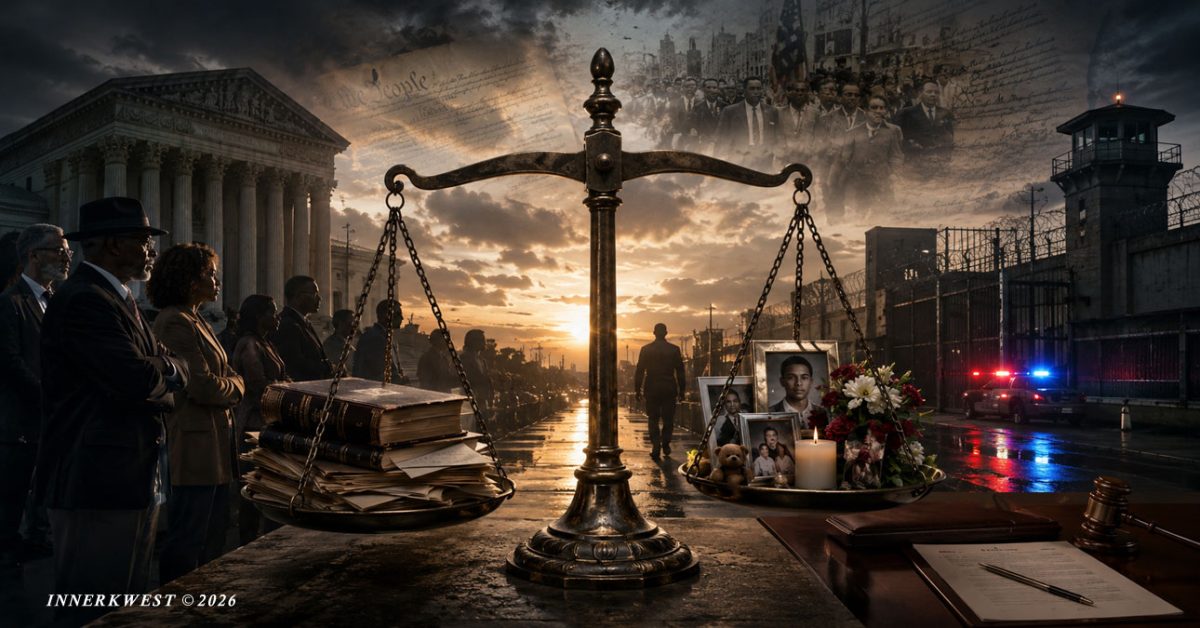
Justice and the Allocation of Time
The legal terminology may differ. Charges change. Defenses change. Jurisdictions change. Yet beneath the statutes, motions, and courtroom arguments lies a reality that most people understand instinctively.
A victim loses time that can never be returned.
Families lose years they expected to share with someone they loved.
Defendants may lose years, sometimes decades, through incarceration.
Others lose no freedom at all.
That is why so many citizens find themselves comparing outcomes even when they do not fully understand the legal distinctions separating one case from another.
They are not performing legal analysis.
They are measuring consequences.
Human beings naturally weigh loss against accountability. They compare the time taken against the time imposed. They compare freedom preserved against freedom removed.
When one person receives decades behind bars while another walks free, the comparison is almost unavoidable.
Most citizens will never read a judicial opinion or study the finer points of criminal procedure. Yet they understand something far more fundamental.
They understand the value of time.
And because they understand time, they inevitably compare how the justice system chooses to allocate it.

The Question That Remains
The issue facing the country is not that Americans disagree about justice.
Disagreement has always been part of the national story.
What continues to command attention is something far more enduring. Generation after generation, Americans keep returning to the same fundamental question: if equal justice stands among the nation’s highest ideals, why does the debate over equal justice never seem to fade from public life?
The question existed long before the latest headlines captured national attention. It appeared in previous generations, under different circumstances, involving different names, different communities, and different courtrooms.
Yet it remains.
New cases emerge. New verdicts are rendered. New controversies dominate the news cycle. The details change, but the underlying conversation proves remarkably durable.
That persistence alone deserves examination.
Most public debates eventually run their course. Most controversies fade with time. Questions that survive for generations are different. They tend to endure because enough people believe something remains unresolved.
Whether one views that conclusion as justified or misplaced, the longevity of the question itself cannot be ignored.
The headlines may change.
The question remains.
At InnerKwest.com, we are committed to delivering impactful journalism, deep insights, and fearless social commentary. Your cryptocurrency contributions help us execute with excellence, ensuring we remain independent and continue to amplify voices that matter.
To help sustain our work and editorial independence, we would appreciate your support of any amount of the tokens listed below. Support independent journalism:
BTC: 3NM7AAdxxaJ7jUhZ2nyfgcheWkrquvCzRm
SOL: HxeMhsyDvdv9dqEoBPpFtR46iVfbjrAicBDDjtEvJp7n
ETH: 0x3ab8bdce82439a73ca808a160ef94623275b5c0a
XRP: rLHzPsX6oXkzU2qL12kHCH8G8cnZv1rBJh TAG – 1068637374
SUI – 0xb21b61330caaa90dedc68b866c48abbf5c61b84644c45beea6a424b54f162d0c
and through our Support Page.
InnerKwest maintains a revelatory and redemptive discipline, relentless in advancing parity across every category of the human experience.
© 2026 InnerKwest®. All Rights Reserved | Haki zote zimehifadhiwa | 版权所有. InnerKwest® is a registered trademark of Inputit™ Platforms Inc. Global. No part of this publication may be reproduced, distributed, or transmitted in any form or by any means without prior written permission. Unauthorized use is strictly prohibited. Thank you for standing with us in pursuit of truth and progress!