
October 4, 2026
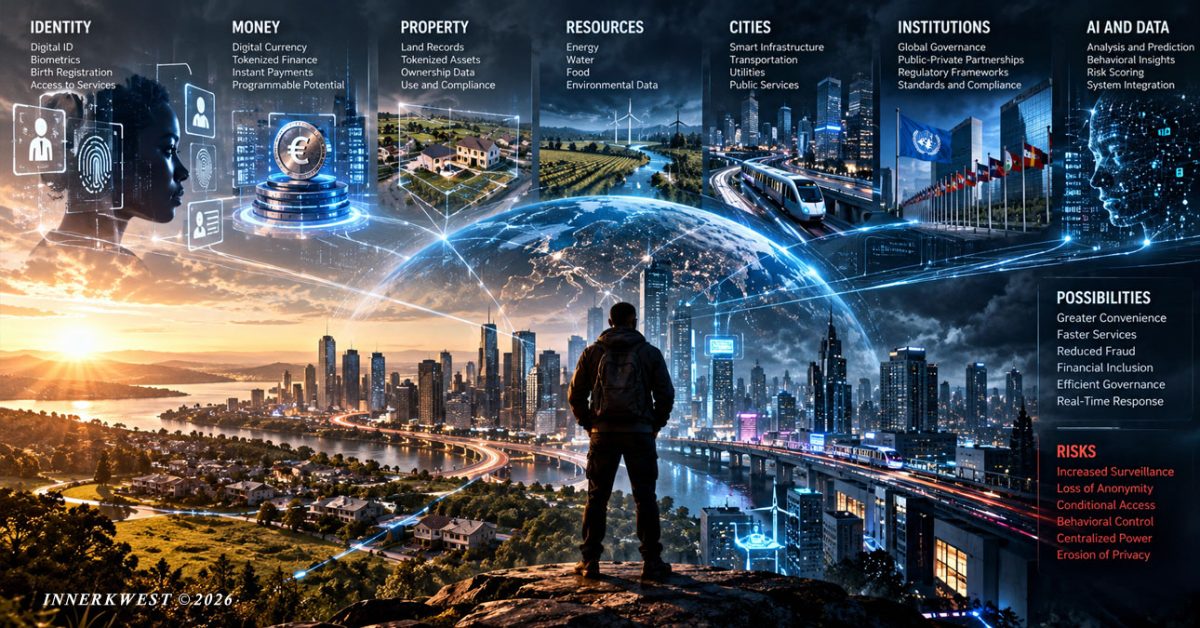
The plans were written decades ago. The technologies came later. What happens when systems for identity, money, property, resources and public administration acquire the ability to speak to one another?
By the InnerKwest Editorial Desk
There is a peculiar difficulty in investigating ideas that have spent years traveling through the territory of conspiracy.
Sometimes the underlying document exists.
Sometimes the quotation is real.
Sometimes the institution actually said what someone claims it said.
And sometimes, after those facts have been established, the argument suddenly crosses a bridge the evidence itself has not crossed.
Agenda 21 exists. The 2030 Agenda exists. Governments have discussed sustainable land use, consumption, legal identity, financial inclusion and the management of natural resources. The World Economic Forum did publish a provocative vision of life in 2030 in which ownership had largely been replaced by services. The United Nations and World Economic Forum did establish a formal partnership intended to accelerate implementation of the Sustainable Development Goals. Central banks are developing digital currencies. Financial markets are being tokenized.
Those things belong to the record.
The proposition that they constitute a decades-old secret blueprint for centralized control of humanity does not automatically follow from them.
But neither does another conclusion that has become almost reflexive whenever this subject appears: that because the most sweeping interpretation has not been established, the institutional developments themselves deserve no further examination.
They do.
Perhaps now more than ever.
Because something has changed since many of these ideas were first written.
The technology has caught up.
Before the Technology Existed
In 1976, delegates gathered in Vancouver for the United Nations Conference on Human Settlements, commonly remembered as Habitat I. Buried inside the recommendations was language about land that reads strikingly nearly fifty years later.
The conference report argued that land, because of its particular role in human settlements, should not be regarded simply as an ordinary market asset. It described private land ownership as a means through which wealth could become concentrated and argued that public control over land use was necessary to protect broader community interests. The recommendations went further, calling for governments to possess detailed knowledge of land use and tenure and appropriate legal and taxation instruments for managing development.
Whatever one thinks of that philosophy, there was nothing secret about it.
It was written down.
Sixteen years later came Agenda 21, adopted at the 1992 Earth Summit. Its reach was expansive: poverty, consumption, human settlements, land, agriculture, forests, water, energy and other dimensions of development. Its chapter on human settlements called for sustainable land-use planning, environmental infrastructure, sustainable transportation and improved settlement management.
Yet there was an enormous practical difference between describing such ambitions in 1992 and administering them comprehensively.
The world still ran largely on paper.
Databases were fragmented. Most people carried physical currency. Artificial intelligence as we understand it today did not exist. Smartphones did not exist. Distributed ledgers did not exist. Satellite observation was primitive compared with today’s systems. The ability to connect an individual’s identity, financial activity, property interests, geographic movements and interactions with public infrastructure across interoperable digital networks remained largely outside ordinary governmental capability.
The ambition could be written.
The architecture was another matter.
Then came thirty years of technological development.
Identity, Finance and the Digital Layer
In 2015, all 193 United Nations member states adopted the 2030 Agenda for Sustainable Development.
Again, much of what it contains is neither mysterious nor particularly controversial on its face: reducing poverty and hunger, improving health and education, expanding access to clean water, strengthening institutions and encouraging sustainable economic development.
But its scope is undeniably broad.
The agenda addresses cities, consumption, infrastructure, natural resources, finance and governance. Target 16.9 calls for legal identity for everyone, including birth registration, by 2030. Goal 17 explicitly seeks partnerships among governments, the private sector and civil society as part of the machinery for achieving the wider agenda.
Legal identity is not sinister. Millions of people without recognized birth registration or identification can struggle to attend school, inherit property, open financial accounts or obtain public services.
But digital identity is also infrastructure.
And infrastructure rarely remains interesting only for the problem that originally justified building it.
Finance was undergoing its own transformation.
Long before today’s arguments surrounding ESG became politically combustible, a 2004 initiative associated with the United Nations Global Compact encouraged financial institutions to incorporate environmental, social and corporate-governance considerations into investment analysis. The report became known as Who Cares Wins. Its underlying proposition was that these factors could affect investment performance and therefore belonged within financial decision-making.
Fifteen years later, the relationship between international institutions and private capital became more explicit. In 2019, the United Nations and the World Economic Forum signed a Strategic Partnership Framework intended to accelerate implementation of the 2030 Agenda. Among its stated areas of cooperation were financing, climate, health, education and digital cooperation.
Again, the agreement was public.
There was no need to discover it in a leaked memorandum.
The more interesting question is what has happened around it since.
Money Begins to Change Form
On September 21, 2026, the European Central Bank launched Pontes.
The name means bridges.
It is an unusually appropriate name.
Pontes allows wholesale transactions involving tokenized assets to settle in central-bank money. It connects distributed-ledger platforms with Europe’s existing TARGET settlement infrastructure. The ECB describes it as the first operational step in a broader strategy for tokenized finance. Its companion initiative, Appia, is intended to develop a blueprint for an integrated European tokenized financial ecosystem by 2028.
The ECB has even announced plans to invest part of its own funds in tokenized securities, gaining practical experience with trading, settlement and portfolio management through the new infrastructure.
This should not be confused with the digital euro intended for ordinary consumers.
That is a separate project.
But it too is advancing.
The ECB is preparing a pilot beginning in the second half of 2027 and says it could be ready for a potential first issuance during 2029, provided the necessary legislation is adopted. The proposed digital euro would operate online and offline, would complement rather than replace cash, and according to the ECB would not be programmable money—that is, money restricted by an issuer to particular products, people, places or periods.
Those safeguards matter.
So does what happened this week.
On September 28, 2026, the ECB opened another round of experimentation and invited private companies, payment providers, public institutions and others to explore potential applications surrounding the digital euro. Among the areas specifically mentioned were transportation and mobility, utility payments, financial inclusion, public-sector automation and smart-city initiatives.
Nothing in that announcement says citizens will be centrally controlled.
Nothing says purchases will be rationed according to environmental scores.
Nothing says private property will disappear.
But something else can be said without speculation.
The boundaries separating money, public services and digital infrastructure are becoming technologically more permeable.
That deserves attention.
The Difference Between a Plan and a Capability
The transcript that prompted this examination makes a much larger argument. It connects Habitat, Agenda 21, Agenda 2030, ESG, the World Economic Forum, digital money, artificial intelligence and population trends into a theory of deliberate centralized control. It eventually speculates about engineered economic pressure, disease, war and population reduction. Those latter propositions are not established by the documentary evidence presented in the transcript.
But dismissing everything surrounding the argument because its final conclusions outrun its evidence would create a different analytical failure.
Systems do not have to originate together to become interoperable later.
A digital identity system can be built to ensure that people receive government services.
A digital currency can be developed to improve payment efficiency.
A smart-city network can be designed to manage transportation.
An environmental database can be created to measure emissions.
A property registry can be digitized to improve title security.
Artificial intelligence can be introduced to find patterns across enormous quantities of information.
Tokenization can be developed to make financial settlement faster and more efficient.
Each proposition can possess its own rationale, its own legislation, its own bureaucracy and its own public-interest justification.
Then somebody builds the bridge.
This is the distinction that deserves preservation in the historical record.
Coordination is not required for convergence to become possible.
Interoperability can produce something that the architects of the individual components never designed.
The internet itself demonstrated that principle. Networks built for particular purposes eventually became an architecture upon which commerce, media, banking, government, surveillance, entertainment, education and human relationships could all operate.
The individual systems did not need a common creator.
They needed common protocols.
What Has Been Imagined
This is also where the famous World Economic Forum material should be treated carefully rather than either hidden or exaggerated.
In 2016, Danish parliamentarian Ida Auken published a futuristic essay through the Forum imagining life in a city in 2030 where goods had largely become services and private ownership had dramatically diminished. The line that escaped into global political culture was unforgettable: “I own nothing.”
The Forum itself described the piece as a thought experiment.
It was not legislation. It was not Agenda 2030. It was not a binding government program.
But thought experiments are not meaningless simply because they are not policy.
They reveal possibilities being contemplated.
That distinction matters.
A society in which transportation is increasingly rented rather than owned, software is licensed rather than purchased, entertainment is subscribed to rather than possessed, housing can become institutionally owned and financial assets increasingly exist as digital entries does not require anyone to confiscate everything.
Ownership can diminish through economics as easily as through law.
Likewise, digital money does not have to be programmable for conditional payment technology to exist. The ECB explicitly distinguishes the two: it says the digital euro itself would remain unrestricted while acknowledging that the infrastructure can facilitate transactions automatically executed when agreed conditions are met.
Again, the distinction matters.
So does the capability.
If the Systems Ever Converge
Now we enter territory that must be identified for what it is.
Not what is happening.
Not what has been proven.
What could become technically possible.
Imagine a mature digital environment in which verified identity, central-bank money, commercial banking, tokenized securities, property records, transportation systems, utilities and government services all possess standardized interfaces.
Add artificial intelligence capable of analyzing enormous quantities of information across those environments.
The resulting system could be extraordinarily convenient.
Fraud could become harder.
Benefits could reach citizens instantly.
Taxes could settle automatically.
Property transfers could occur in minutes.
Emergency assistance could arrive without paperwork.
Transportation networks could adapt dynamically.
Financial crime could become easier to trace.
Government itself could become dramatically more efficient.
The same architecture would also possess another characteristic.
It would know considerably more.
And if political circumstances changed, the question would no longer be whether the technical capacity existed to connect previously separate areas of life.
The question would become what the law permitted those connections to do.
That is why privacy rules matter now.
That is why cash matters.
That is why property rights matter.
That is why judicial oversight matters.
That is why decentralized systems matter.
And that is why technical architecture deserves scrutiny before rather than after its capabilities become indispensable.
The ECB currently says its proposed digital euro would not replace cash, would not be programmable money, and would be constructed with substantial privacy protections. Offline payments are intended to approach cash-like privacy, while the Eurosystem says it would not be able to directly identify individuals from their online payment information.
Those are important protections.
They also illustrate something easily overlooked.
If society believes those protections are important enough to promise today, then society should consider whether they are important enough to make difficult to remove tomorrow.
Because administrations change.
Governments change.
Emergencies happen.
Wars happen.
Economic crises happen.
Technology changes.
The institution remains.

The Architecture Remains
Perhaps the mistake in conversations about Agenda 21, Agenda 2030, digital currencies and global institutions has been the insistence that only two interpretations are available.
Either there is a master plan.
Or there is nothing to see.
History is rarely that accommodating.
Institutions develop separately. Technologies arrive unexpectedly. Economic incentives alter behavior. Governments discover new uses for old authorities. Private companies acquire capabilities once possessed only by states. States acquire capabilities once imagined only in science fiction.
And occasionally the pieces begin to fit together.
No document examined by InnerKwest establishes that the United Nations, World Economic Forum, European Central Bank, asset managers and national governments have secretly agreed upon a unified system for controlling human life.
The record does establish something considerably less theatrical and perhaps more consequential.
International institutions have spent decades discussing how societies use land, resources, cities, finance and consumption.
Governments have agreed upon universal development objectives that include legal identity and broad public-private cooperation.
Financial institutions have incorporated nonfinancial objectives into investment frameworks.
Central banks are building infrastructure for tokenized finance.
Digital currencies are moving from conceptual papers toward pilots.
Artificial intelligence has made previously unimaginable quantities of information interpretable.
And institutions are already examining how digital payment infrastructure might interact with public services and smart cities.
Those are not predictions.
Those are pieces already on the table.
What has not been established is who, if anyone, ultimately intends to assemble them.
Perhaps no one will.
Perhaps democratic institutions will insist that some systems remain deliberately separated.
Perhaps privacy architecture will become stronger.
Perhaps cash will remain permanently available.
Perhaps decentralized technologies will create counterweights powerful enough to prevent excessive concentration.
Or perhaps, during some future crisis, governments will discover that systems constructed independently can suddenly accomplish far more when connected.
That possibility is not proof of conspiracy.
It is a reason for vigilance.
The twentieth century taught societies to ask who controlled the factories, the armies, the oil and the banks.
The twenty-first may require another question.
Who controls the connections?
Because the most consequential system of the future may not be the one somebody builds from the ground up.
It may be the one that already existed in pieces.
Waiting for the bridges.
At InnerKwest.com, we are committed to delivering impactful journalism, deep insights, and fearless social commentary. Your cryptocurrency contributions help us execute with excellence, ensuring we remain independent and continue to amplify voices that matter.
To help sustain our work and editorial independence, we would appreciate your support of any amount of the tokens listed below. Support independent journalism:
BTC: 3NM7AAdxxaJ7jUhZ2nyfgcheWkrquvCzRm
SOL: HxeMhsyDvdv9dqEoBPpFtR46iVfbjrAicBDDjtEvJp7n
ETH: 0x3ab8bdce82439a73ca808a160ef94623275b5c0a
XRP: rLHzPsX6oXkzU2qL12kHCH8G8cnZv1rBJh TAG – 1068637374
SUI – 0xb21b61330caaa90dedc68b866c48abbf5c61b84644c45beea6a424b54f162d0c
and through our Support Page.
InnerKwest maintains a revelatory and redemptive discipline, relentless in advancing parity across every category of the human experience.
© 2026 InnerKwest®. All Rights Reserved | Haki zote zimehifadhiwa | 版权所有. InnerKwest® is a registered trademark of Inputit™ Platforms Inc. Global. No part of this publication may be reproduced, distributed, or transmitted in any form or by any means without prior written permission. Unauthorized use is strictly prohibited. Thank you for standing with us in pursuit of truth and progress!