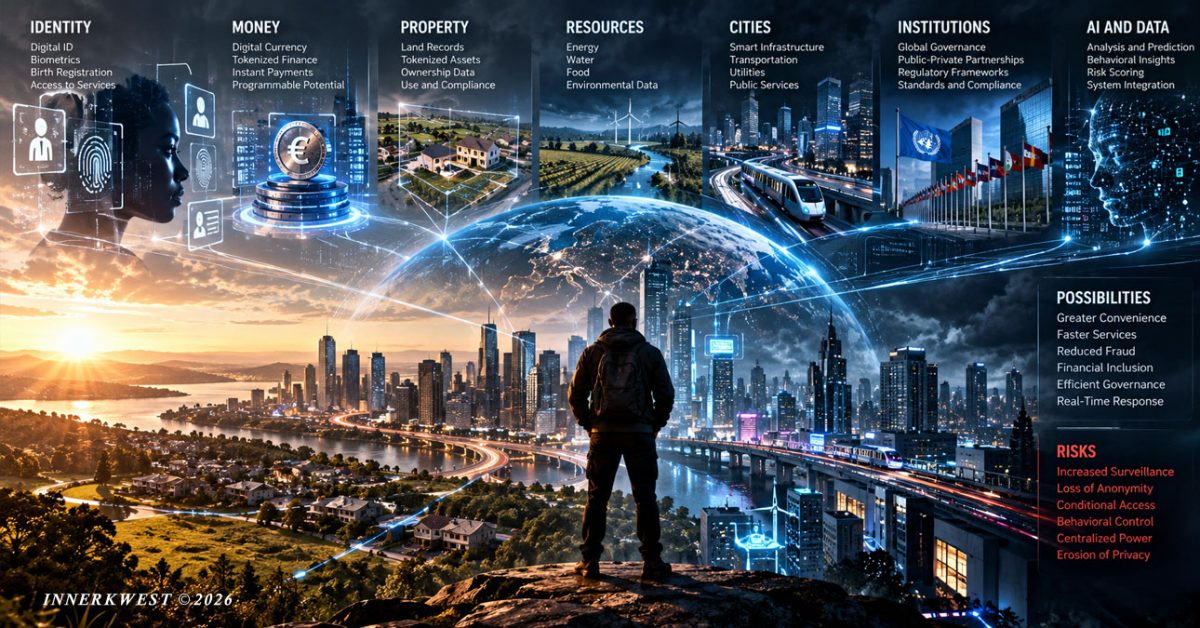
Digital identity, tokenized finance, artificial intelligence, smart cities and public infrastructure are developing for different purposes under different institutions. No evidence establishes a single master plan connecting them. But as the technologies become interoperable, a different question emerges: what becomes possible if systems once built separately acquire the ability to operate together?
Participation Without Protection: How Democracy Is Quietly Devoured in the Age of Code
Democracy is not collapsing overnight—it is being quietly reshaped by algorithmic systems, data extraction, and monolithic infrastructures operating beyond democratic accountability. In the age of code, participation itself has become fuel, feeding hyperscale systems that monetize civic life while reminding us that neutrality, at scale, is never neutral.
Centralization Is Not Neutral
Centralization is often framed as efficiency or protection. In practice, it is architectural. As Western systems converge and memory expands, privacy erodes not by decree, but by design—leaving discretion increasingly scarce.
The American Dream Didn’t Die. It Migrated.
For decades, the American Dream functioned less as a promise than as a system—one that plausibly converted effort into ownership and participation into upward mobility. Today, that system is under strain. As opportunity detaches from geography, capital and talent migrate toward environments where rules remain legible and progress still feels attainable.