
October 7, 2026
SPECIAL INVESTIGATION
Investment, Influence, and the Continent That Refuses to Be Negotiated as One
By the InnerKwest Editorial Desk
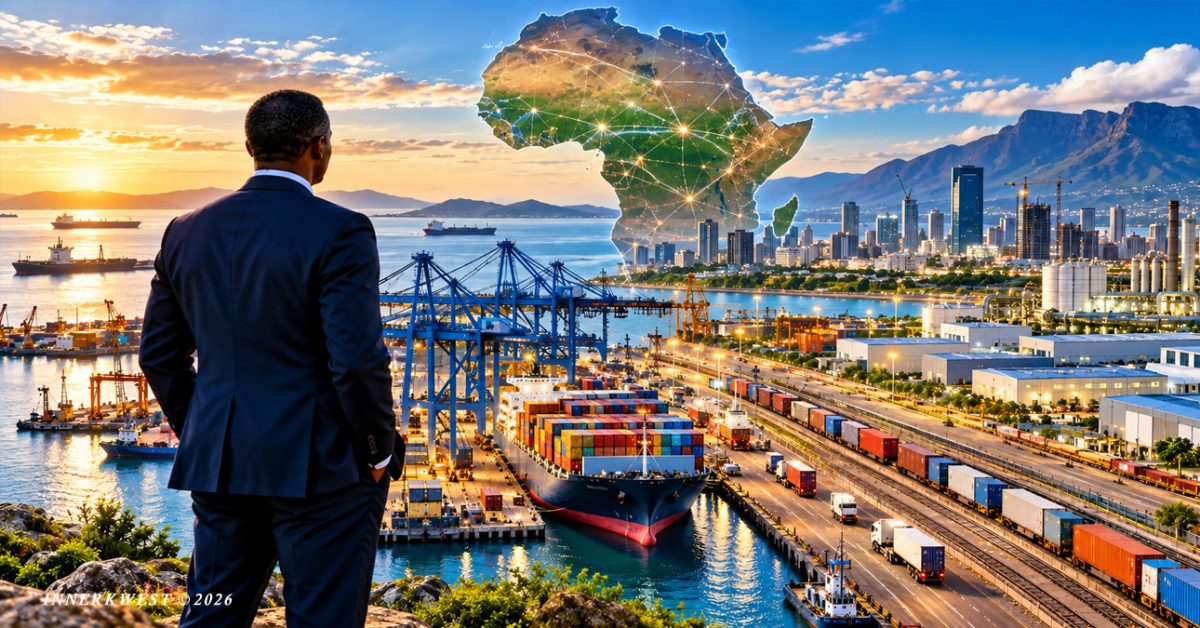
The world’s attention is returning to Africa with unusual intensity. Governments, sovereign wealth funds, multinational corporations, development institutions, and private investors are pursuing partnerships involving ports, critical minerals, logistics, manufacturing, artificial intelligence, agriculture, finance, and security. Yet the defining story may not be who has arrived. It may be that Africa is entering this new era with more negotiating options than at any point in its modern history. This investigation examines the forces converging upon the continent, the historical memory shaping African decision-making, and the strategic questions that may determine whether this century produces another period of extraction—or a period of industrial transformation.
A Different Century
There are moments in history when the movement itself becomes impossible to ignore.
Not because a single event changes the world overnight, but because institutions that rarely move together begin arriving at the same destination from entirely different directions. Investors alter their portfolios. Governments revise long-term strategies. Development banks redirect capital. Military planners reassess geography. Universities establish new research partnerships. Manufacturers begin searching for new supply chains. Shipping companies redraw routes. Headlines appear disconnected, each describing its own isolated development, yet together they suggest that something larger has quietly entered motion.
Africa appears to be approaching one of those moments.
For generations, discussions about the continent were often framed through the language of humanitarian assistance, conflict, debt, or underdevelopment. Those realities have never disappeared entirely, nor should they be ignored. Yet they no longer tell the whole story. Increasingly, conversations taking place in boardrooms, ministries, research institutes, investment conferences, and diplomatic summits revolve around a different vocabulary altogether.
Critical minerals.
Artificial intelligence.
Advanced manufacturing.
Trade corridors.
Industrial policy.
Energy transition.
Food security.
Semiconductor supply chains.
Digital infrastructure.
Population growth.
Those subjects rarely occupy the same newspaper page.
Increasingly, they occupy the same strategic discussion.
The shift is subtle enough that it can be overlooked when viewed one headline at a time. A Japanese delegation announces expanded industrial cooperation in East Africa. A Gulf logistics company develops another port along an emerging trade corridor. Critical mineral discoveries generate renewed international interest. Technology companies search for secure sources of rare earth elements essential to artificial intelligence and advanced electronics. African governments negotiate new manufacturing agreements rather than simply expanding raw commodity exports. The African Continental Free Trade Area continues laying the institutional foundation for what could eventually become the world’s largest integrated trading bloc by participating countries.
Individually, each development appears significant.
Collectively, they describe something much larger.
They suggest that Africa is no longer being viewed primarily as a peripheral marketplace.
It is increasingly being viewed as strategic infrastructure.
That distinction matters because infrastructure alters the nature of competition.
Markets compete for customers.
Infrastructure competes for permanence.
Ports are not constructed for quarterly earnings reports. Railways are not financed for a single election cycle. Industrial parks, logistics corridors, electrical grids, processing facilities, fiber-optic networks, and manufacturing ecosystems are investments measured in decades rather than months. They shape patterns of commerce long after the original agreements have faded from public attention.
History has seen this before.
The railroads that transformed North America were never simply about trains. They determined where cities emerged, where factories were built, where capital accumulated, and where political influence followed. Maritime ports have always represented far more than places where ships unload cargo. They determine commercial geography itself. Whoever connects production to markets frequently shapes the broader economic landscape surrounding both.
Africa now finds itself at the center of a remarkably similar conversation.
Yet there is another difference that distinguishes this period from nearly every era that preceded it.
The world is not arriving alone.
History Never Leaves the Negotiating Table
Every negotiation inherits more participants than those physically seated around the table.
Some arrive carrying investment proposals.
Others arrive carrying engineering plans, financial models, memoranda of understanding, or diplomatic initiatives.
History arrives carrying memory.
For Africa, that memory is neither abstract nor particularly distant.
European colonial rule reshaped political boundaries across the continent, redirected economies toward extraction, reorganized transportation networks around the export of raw materials, and frequently subordinated local industrial development to metropolitan interests. Independence altered political sovereignty but did not instantly erase the institutional, financial, or commercial structures inherited from the colonial period. Throughout the decades that followed, many African governments navigated Cold War competition, structural adjustment programs, commodity dependence, debt crises, and repeated efforts to redefine their place within the international economy.
Those experiences continue influencing contemporary decision-making.
They help explain why modern discussions surrounding ports, railways, mining concessions, digital infrastructure, energy projects, agricultural investment, and industrial development are rarely treated as purely commercial transactions. For many African policymakers, they are also questions of sovereignty.
Who finances the infrastructure?
Who owns it?
Who operates it?
Who trains the workforce?
Where does the technology originate?
Who performs the processing?
Who retains the intellectual property?
Where is value ultimately created?
Those questions cannot be dismissed as relics of another century.
They are products of another century.
History rarely disappears.
It simply changes the vocabulary through which it speaks.
That historical perspective also explains why contemporary partnerships increasingly receive close scrutiny across the continent. Agreements are evaluated not only according to promised investment but also according to institutional design, technology transfer, local participation, environmental standards, workforce development, financing terms, dispute resolution mechanisms, and long-term national interests. The discussion has become considerably more sophisticated than choosing between foreign investors.
Increasingly, it concerns the architecture of development itself.
That evolution represents one of the continent’s most important, and perhaps least appreciated, transformations.
Fifty-Four Negotiating Tables
One of the easiest mistakes made by outside observers is speaking about Africa as though it were negotiating with one voice.
It is not.
Nor has it ever been.
Africa is home to fifty-four internationally recognized sovereign states, each possessing its own constitution, political institutions, legal traditions, fiscal priorities, security concerns, industrial ambitions, demographic realities, and diplomatic relationships. Some are major energy producers. Others possess globally significant deposits of cobalt, copper, lithium, graphite, rare earth elements, uranium, manganese, platinum, or niobium. Some seek to become manufacturing centers. Others prioritize agriculture, financial services, logistics, tourism, technology, or regional commerce.
Each government negotiates from its own circumstances.
That diversity presents a challenge frequently underestimated by external powers.
There is no single African negotiation.
There are fifty-four.
A logistics agreement in Senegal differs fundamentally from a semiconductor supply-chain discussion in Kenya. An industrial manufacturing partnership in Ethiopia raises different considerations than an energy project in Namibia or a mining concession in the Democratic Republic of the Congo. Morocco’s priorities are not identical to Ghana’s. Botswana’s development strategy differs from Nigeria’s. Rwanda approaches technology differently than Angola approaches energy. Egypt’s geopolitical considerations differ from those of Zambia.
Yet another dynamic operates simultaneously.
While fifty-four governments pursue fifty-four national strategies, continental institutions increasingly seek common objectives.
The African Union.
The African Continental Free Trade Area.
Regional economic communities.
Shared infrastructure initiatives.
Common diplomatic positions.
The Ezulwini Consensus regarding Security Council reform.
Integration and sovereignty now advance together rather than standing in opposition.
That may become one of the defining characteristics of Africa’s twenty-first century.
Externally, the continent becomes increasingly integrated as a strategic marketplace.
Internally, it remains composed of sovereign governments, each retaining the authority to determine its own partnerships and its own future.
For outside powers accustomed to negotiating with singular national governments, that reality introduces remarkable complexity.
For Africa, it may represent one of its greatest strategic strengths.
Because no matter how significant global interest becomes, no country, corporation, or institution negotiates with Africa.
They negotiate with Africans.

When the Footprints Begin to Converge
History has a curious habit.
Major transitions seldom announce themselves with a single defining event. More often they emerge quietly, almost imperceptibly, until enough seemingly unrelated developments begin pointing toward the same destination. One delegation visits. Another signs an infrastructure agreement. A development bank approves financing. A port expands. A university launches a research partnership. A logistics corridor receives another investment. Months later another government arrives pursuing an entirely different objective, yet somehow choosing many of the same locations.
Individually, these decisions appear ordinary.
Viewed together, they begin resembling a map.
That may be where Africa now finds itself.
The renewed attention surrounding the continent is frequently described as competition. There is certainly evidence of competition. Yet that word alone fails to explain what is taking place. Competition suggests rivals pursuing identical prizes. The landscape unfolding across Africa appears considerably more complex. Governments arrive carrying different priorities. Some seek resilient supply chains. Others pursue long-term food security. Some require strategic minerals essential to advanced manufacturing and artificial intelligence. Others invest in transportation networks, digital infrastructure, telecommunications, pharmaceuticals, agriculture, or financial services.
Different objectives.
Remarkably similar destinations.
That convergence deserves more attention than any single announcement.
It suggests that institutions operating independently have begun assigning increasing strategic importance to the same continent for entirely different reasons.
That rarely happens by accident.
Ports Before Politics
Every economy has an address.
Long before factories begin producing finished goods or financial districts begin allocating capital, commerce must first arrive somewhere. Ships require harbors. Containers require terminals. Railways require destinations. Roads require gateways capable of connecting domestic production with international markets.
Ports become those gateways.
Over time they become considerably more.
Modern ports are no longer isolated stretches of waterfront designed simply to unload cargo before returning ships to sea. Increasingly they function as integrated commercial ecosystems. Warehouses rise beside container terminals. Rail lines extend inland toward manufacturing centers. Free economic zones emerge around logistics hubs. Customs procedures become digitized. Distribution centers attract additional investment. Manufacturers begin locating nearby because transportation costs decline and export opportunities expand.
Commerce follows infrastructure.
Industry often follows commerce.
The implications extend well beyond shipping.
Across Africa, international logistics companies have increasingly invested not merely in maritime terminals but in complete trade corridors linking ports with inland transportation, industrial parks, storage facilities, and regional distribution networks. These investments frequently promise faster trade, improved efficiency, lower transportation costs, and greater regional integration.
Those are significant opportunities.
They also raise equally significant questions.
Who owns the infrastructure once construction has finished?
Who operates it?
How long do concession agreements remain in force?
Where are disputes adjudicated?
What technology accompanies the investment?
Who trains the next generation of engineers, technicians, customs specialists, and logistics managers?
The cranes standing above a harbor tell only part of the story.
The contracts beneath them tell the rest.
There is another reason ports deserve attention.
They tend to outlive governments.
Administrations change.
Policies evolve.
Political alliances shift.
Ports remain.
The decisions surrounding their ownership, management, financing, and strategic direction frequently continue shaping national economies long after those who negotiated the original agreements have left public office.
Infrastructure remembers.
The Minerals Beneath the Conversation
For decades, discussions surrounding Africa’s natural resources often focused upon extraction.
Oil.
Gold.
Diamonds.
Copper.
The conversation has begun changing.
Increasingly, the world’s attention has turned toward materials that rarely appear in ordinary public discussion yet occupy an essential place inside modern industry. Rare earth elements. Graphite. Lithium. Cobalt. Manganese. Niobium. Platinum group metals. Materials that, until recently, attracted comparatively limited public attention now sit near the center of conversations involving artificial intelligence, electric vehicles, advanced batteries, aerospace engineering, telecommunications, renewable energy, semiconductors, and defense manufacturing.
The minerals themselves have not changed.
The world around them has.
As industries pursue electrification, automation, and increasingly sophisticated computing systems, the strategic importance of these resources has expanded dramatically. What once appeared to be ordinary mining projects increasingly intersects with national industrial strategies, supply-chain resilience, and technological competition.
Africa happens to possess many of the resources upon which that future depends.
That reality has altered the conversation.
Not simply because minerals generate export revenue.
Because they increasingly influence where future industries may choose to locate.
Yet perhaps the most important question no longer concerns what lies beneath the ground.
It concerns what happens after those resources leave it.
Beyond Extraction
History has rarely rewarded those who export only raw materials.
The greatest economic transformations have generally occurred where extraction evolved into processing, processing expanded into manufacturing, manufacturing generated research, and research ultimately produced innovation. Each stage created additional layers of employment, technical knowledge, domestic capital formation, and industrial capability.
Africa increasingly appears determined to participate in that larger progression.
Across the continent, conversations surrounding mining are gradually expanding beyond licensing agreements toward refining capacity, local processing, battery manufacturing, fertilizer production, steel, petrochemicals, semiconductor inputs, engineering education, and industrial ecosystems capable of retaining greater portions of the value chain within national economies.
The distinction is profound.
Exporting ore creates revenue.
Processing minerals creates industries.
Industries create capabilities.
Capabilities endure.
That shift may ultimately become more significant than the discoveries themselves.
Mineral wealth has appeared throughout history.
Industrial capacity has always been considerably harder to build.
Perhaps that explains why discussions surrounding ports, logistics, railways, energy generation, technical universities, digital infrastructure, manufacturing zones, and technology transfer increasingly appear within the same conversation.
They are no longer separate discussions.
They are different components of the same industrial architecture.
And once that architecture begins taking shape, another pattern quietly emerges.
The institutions arriving in Africa may be pursuing different objectives.
Increasingly, however, they are participating in the construction of the same century.
Different Partners. Different Propositions.
The architecture may be shared.
The propositions are not.
This is where the emerging competition for Africa becomes more difficult to describe, because the governments, corporations, development institutions, sovereign funds, universities, and security partners arriving across the continent do not bring interchangeable offers. Their interests overlap, sometimes considerably, but the institutional traditions behind them differ. So do their appetites for risk, their financing structures, their political expectations, their technologies, their time horizons, and the things they ultimately expect to receive in return.
China’s engagement, for example, has accumulated over decades through infrastructure, trade, construction, financing, mining, telecommunications, industrial parks, and increasingly manufacturing and technology. The current Forum on China-Africa Cooperation framework reaches considerably beyond the familiar image of Chinese-built roads and railways. Its 2025–2027 action plan explicitly reaches into local value chains, critical-mineral processing, industrial parks, digital infrastructure, technology transfer, laboratories, vocational training, agricultural modernization, and higher-value manufacturing.
Japan arrives through a different institutional tradition. TICAD, which Japan has led since 1993 alongside multilateral partners, has increasingly placed private investment, human capital, industrial development, technology, and economic resilience near the center of the relationship. At TICAD 9 in Yokohama, the conversation extended to local processing of critical minerals, value addition, joint ventures and technology transfer, while Japan also proposed an Indian Ocean–Africa economic initiative intended to connect African industrial development more closely with India, the Middle East and the wider Indian Ocean economy.
The Gulf states introduce still another proposition.
Their geography matters.
For countries whose prosperity has long depended upon the movement of energy, capital, aviation, shipping and trade between continents, African ports are not distant infrastructure projects. They sit across maritime routes connecting the Atlantic, Mediterranean, Red Sea and Indian Ocean. Investments in terminals, logistics networks, warehouses, economic zones and inland corridors therefore fit naturally within a commercial architecture already stretching from Asia through the Middle East and into Europe.
The model can be seen in the physical landscape. DP World now operates port and logistics interests across several African markets, while its newer Mombasa Industrial Park venture in Kenya is being designed not simply as another cargo facility but as a 222-hectare special economic zone intended to attract investment and expand manufacturing capacity. Its broader corporate model deliberately connects ports, warehousing, industrial land and logistics as pieces of one platform.
Others arrive with their own combinations of security cooperation, development finance, agriculture, technology, energy, diplomacy, research or market access.
The temptation is to arrange these partners into familiar columns.
West.
East.
Gulf.
Global South.
Old powers.
New powers.
But Africa’s opportunity may lie precisely in refusing that arrangement.
A government seeking a railway need not choose its university partner from the same country financing the railway. A nation developing lithium reserves need not obtain its artificial-intelligence infrastructure from the country purchasing the lithium. Port management, agricultural research, defense cooperation, pharmaceutical manufacturing, telecommunications, power generation and engineering education do not inherently belong inside one geopolitical package.
That is a very different form of sovereignty.
It is sovereignty exercised through optionality.
And optionality becomes considerably more valuable when several institutions want access to the same geography at the same time.
The Geography of Capital
Money does not arrive on a continent evenly.
It follows something.
Sometimes minerals.
Sometimes population.
Sometimes political stability.
Sometimes shipping lanes.
Sometimes energy.
Sometimes proximity to markets.
Sometimes a government capable of moving an agreement from a conference table into the physical world.
Look closely enough at the emerging investment map and certain places begin appearing repeatedly.
The eastern coast opens toward the Indian Ocean, the Gulf and Asia. The western coast faces Europe and the Atlantic Americas. North Africa sits within commercial reach of the Mediterranean while also possessing access to the continent below it. Southern Africa contains mature financial and industrial systems alongside extraordinary mineral resources. Central Africa holds resources essential to technologies being designed thousands of miles away.
Then there are the corridors.
A port without an inland connection can move containers.
A port connected to rail, highways, energy, industrial zones, fiber, customs systems and neighboring markets can reorganize an economy.
That distinction helps explain why the geography of African investment is slowly moving inland.
The most consequential infrastructure may no longer be the harbor itself, but the network that begins at the harbor and refuses to stop there.
This creates an entirely different calculation for African governments.
A railway passing through several countries can become more valuable than a railway terminating at a mine. An electrical network serving an industrial region can become more transformative than one designed around a single extraction project. A fiber corridor connecting universities, businesses and data centers may eventually matter as much as the highway running beside it.
The African Continental Free Trade Area changes the scale of that calculation.
Infrastructure built within one country can increasingly be evaluated according to what it might connect beyond that country’s borders. A manufacturer does not necessarily have to regard the domestic population as the outer boundary of its potential market. A logistics hub does not have to serve only the nation in which the cranes happen to stand. Mineral processing in one country can feed manufacturing in another. Components can cross borders before becoming finished products somewhere else.
The map begins behaving differently.
So does capital.
And somewhere inside that transformation, an old question quietly becomes a new one.
For generations, much of Africa’s infrastructure was designed to move resources outward.
What happens when the same infrastructure is deliberately designed to move African commerce across Africa?
The answer cannot be found in concrete alone.
It will be found in institutions.
The Agreements Remain
There is a peculiar moment in almost every major infrastructure announcement when the future appears uncomplicated.
Officials gather.
Documents are signed.
Architectural renderings appear.
Investment figures are announced.
Cameras capture the handshake.
Then everyone eventually leaves the room.
The agreement does not.
A thirty-year port concession will encounter governments that did not negotiate it. A railway financing arrangement may survive several presidents. A mineral-processing agreement can influence industrial policy long after commodity prices have changed. Digital infrastructure may still be operating when the technology that originally justified its construction has become obsolete.
The agreements remain.
This is why the quality of African negotiating institutions may ultimately prove more consequential than the volume of foreign capital arriving on the continent.
Capital can build.
Institutions decide what is being built toward.
The distinction becomes especially important when infrastructure, mineral rights, financing, technology and national security begin occupying the same agreement. The immediate question may concern investment. The enduring questions concern jurisdiction, ownership, taxation, data, arbitration, training, maintenance, procurement, local participation, intellectual property and the ability of future governments to act.
None of this argues against long agreements.
Infrastructure often requires them.
Investors require sufficient certainty to recover capital. Ports require years to develop. Railways require planning beyond electoral calendars. Manufacturing facilities cannot be financed sensibly if every political transition threatens to reopen the underlying arrangement.
Durability can be an economic asset.
But durability makes institutional competence more important, not less.
The strongest negotiating position therefore may not always belong to the country possessing the largest mineral reserve or the busiest harbor. It may belong to the country capable of understanding what an agreement will mean twenty years after the delegation has returned home.
That requires lawyers.
Engineers.
Economists.
Geologists.
Computer scientists.
Trade specialists.
Universities.
Civil servants whose institutional memory survives changes of government.
It requires something less visible than infrastructure but ultimately inseparable from it.
State capacity.
History rarely disappears.
Neither do poorly constructed agreements.
The Partnership Economy
Perhaps the most consequential development, then, is not the number of countries seeking deeper relationships with Africa.
It is the possibility that African governments can begin comparing those relationships against one another.
Not rhetorically.
Institutionally.
What financing structure is being offered?
What remains after the financing has been repaid?
How many African engineers will understand the technology when the foreign contractors leave?
Can the equipment be maintained locally?
Will a mineral be refined before export?
Can a domestic company enter the supply chain?
Does a university partnership produce research capacity or merely exchange ceremonies?
Does an artificial-intelligence investment leave behind computing infrastructure, data expertise and trained scientists?
Will an industrial park actually manufacture?
Does the port connect to African commerce, or merely accelerate the movement of African resources toward someone else’s industry?
These questions do not require hostility toward foreign investment.
They require seriousness about African development.
Indeed, the growing number of potential partners may allow governments to ask them with greater confidence than was possible when financing options were narrower. Competition among external powers can create pressure, but competition can also create negotiating room.
The decisive question is what African institutions do with it.
That question already extends beyond economics.
The African Union continues to advance the Ezulwini Consensus, insisting upon permanent African representation on the United Nations Security Council while the existing veto system remains. In May 2026, the chairperson of the African Union Commission again presented that position not as a request for accommodation but as a matter of representation in institutions still reflecting an earlier geopolitical order.
The principle beneath that argument reaches further than the Security Council.
If Africa is becoming indispensable to global mineral supply chains, shipping routes, energy transitions, food systems, manufacturing strategies, digital expansion and demographic growth, then the institutional architecture governing those systems becomes increasingly difficult to separate from the economic architecture developing around them.
Investment and representation begin touching the same question.
Who participates in constructing the rules?
That may be why the next stage of African partnership cannot be measured solely by the amount of capital entering the continent.
Capital matters.
Infrastructure matters.
Technology matters.
Security matters.
But the deeper measure may be what remains when each partnership has matured.
A port can remain.
A mine can remain.
A factory can remain.
More important still, knowledge can remain.
Engineers can remain.
Research institutions can remain.
Manufacturing capacity can remain.
African companies capable of competing beyond their own borders can remain.
And perhaps that is where the meaning of partnership finally separates itself from the older language of access.
Access asks what can be reached.
Partnership asks what can be built.
Fifty-four governments will answer that question differently. They should. Their resources differ. Their histories differ. Their institutions differ. Their ambitions differ.
Yet across those differences, a continental possibility is beginning to emerge.
For perhaps the first time in the modern competition surrounding Africa, the most important contest may not be the one taking place among the powers arriving.
It may be the one taking place among the propositions they bring.
And Africa does not have to accept them whole.
What Remains at the Table
There is an old assumption about negotiation that becomes less useful the larger the agreement becomes.
It is the belief that power belongs principally to the party bringing the money.
Sometimes it does.
But capital entering a country cannot negotiate with itself. It requires permission, law, land, institutions, infrastructure, labor, political stability and, in many cases, access to something that cannot simply be relocated elsewhere. A copper deposit cannot be moved to another continent because negotiations become difficult. Neither can a coastline. A shipping corridor cannot be recreated by financial engineering. Population, geography and proximity retain their own forms of leverage.
For African governments, recognizing that leverage is only the beginning.
Knowing how to preserve it is something else.
The difference can be found in places rarely photographed when major agreements are announced. Inside ministries. Across regulatory agencies. Within geological surveys and customs authorities. In universities where engineers are trained. In the lawyers who understand the consequences of a clause that may remain in force for thirty years. In civil servants capable of remembering why an earlier government accepted one provision and rejected another.
Presidents may sign agreements.
Institutions must live with them.
That is where the conversation becomes considerably less glamorous and considerably more important.
A nation does not build negotiating strength merely by possessing something the world wants. It builds strength by understanding what it possesses, what it may become worth, what can be built around it, what alternatives exist, and what should never be surrendered simply because capital has arrived with urgency.
History offers enough instruction here without requiring another lecture from it.
The continent has exported enormous quantities of value before.
What proved much harder to export was prosperity.
The People on Africa’s Side of the Table
Perhaps the next great African infrastructure project will not be visible from the air.
No cranes.
No railway.
No container terminal stretching along the coast.
It may instead be a generation of people capable of understanding all three.
This is where universities become part of the industrial story.
Not as ceremonial partners attached to agreements after the important decisions have already been made, but as places where national capability is accumulated. Mining requires geology, metallurgy and environmental science. Ports require engineering, logistics and increasingly sophisticated software. Artificial intelligence requires mathematics, computing infrastructure, data expertise and enormous quantities of electricity. Modern agriculture reaches into genetics, water systems, satellite imaging and supply-chain management. Advanced manufacturing eventually demands something more difficult than machinery: people capable of repairing it, improving it and, one day, designing what replaces it.
Technology transfer means very little if knowledge never transfers with it.
A factory can be imported.
Capability cannot.
It has to be learned.
This is one reason the industrial ambitions now appearing across Africa cannot be separated from education. The African Union’s own long-term framework places skills, science, technology, manufacturing, industrialization and value addition within the same vision of economic transformation. AfCFTA, likewise, was never conceived merely as an exercise in lowering tariffs; its larger promise rests partly upon creating enough continental scale for African production to travel farther inside Africa itself.
The implications are easy to miss.
If a country processes more of its minerals locally but imports nearly all of the machinery, software and specialized knowledge required to operate the processing plants, something has changed.
But not everything.
If another generation learns to maintain those systems, more has changed.
If its universities begin improving them, the equation changes again.
And if domestic firms eventually begin building portions of the technology themselves, the original investment has done something far more consequential than create employment.
It has helped create competence.
Capabilities endure.
A Continent Without a Single Negotiating Room
There is nevertheless a complication that no amount of continental optimism should conceal.
Africa’s growing strategic importance does not dissolve national interest.
Ghana will make decisions for Ghana.
Kenya will make decisions for Kenya.
Botswana, Nigeria, Namibia, Ethiopia, Morocco, South Africa, Senegal, Zambia and the Democratic Republic of the Congo will approach their resources and their development from circumstances that are distinctly their own.
They should.
Sovereignty would mean very little otherwise.
The harder question is whether national sovereignty and continental leverage can mature alongside one another without either pretending to replace the other.
AfCFTA offers one possible answer.
Its significance is not that fifty-four national economies suddenly become indistinguishable. They do not. Governments retain borders, laws, tax systems, industrial priorities and political responsibilities to their own populations. The significance lies elsewhere: in the possibility that a factory built for one national market may increasingly reach consumers beyond it, that components produced in one country can enter an industrial chain in another, and that African producers may eventually encounter fewer economic walls as they move across African geography.
That changes what scale means.
For decades, one of the difficulties confronting industrial development in smaller economies has been painfully straightforward. A factory requires customers. Some domestic markets alone cannot provide enough of them to justify the capital required for sophisticated manufacturing.
A continental market begins altering that arithmetic.
Not immediately.
Not uniformly.
And certainly not merely because an agreement exists on paper.
Roads must still connect. Customs systems must work. Payments must clear. Standards must become intelligible across borders. Political commitments must survive contact with domestic interests. Rail gauges, power supplies, ports, regulations and digital systems do not harmonize themselves because leaders have signed a treaty.
The work is less romantic than the vision.
Perhaps that is precisely why it matters.
The African Union now consists of fifty-five member states, while the AfCFTA agreement has been signed across the membership following Eritrea’s June 2026 signature. The significance is not uniformity; it is the construction of machinery through which sovereign economies can trade at continental scale.
A continent need not negotiate every foreign partnership collectively to acquire greater collective leverage.
Sometimes leverage emerges simply because the alternatives have multiplied.
A mineral can be processed in one country and incorporated into manufacturing somewhere else on the continent. A landlocked economy can gain strategic value through a corridor reaching another country’s port. An industrial zone can serve markets beyond the flag flying above it. Universities can collaborate across borders. African capital can move toward African projects.
The geography begins to loosen.
The sovereignty remains.
That balance may prove more useful than the search for a single African voice on every economic question.
There will not always be one.
There does not need to be.

The Discipline of Choice
Eventually every partnership reaches the same quiet test.
Not who came.
Not which flag appeared beside the African one at the signing ceremony.
Not whether the investment originated in Washington, Beijing, Tokyo, Abu Dhabi, Brussels, New Delhi, Seoul, Ankara or somewhere not yet prominent in the competition.
The more durable question is what the relationship leaves behind.
That is a different standard.
It allows a government to welcome capital without confusing investment with development. It permits cooperation with several powers without inheriting every rivalry among them. It makes room for security relationships where security is required, technology partnerships where knowledge can be gained, infrastructure finance where infrastructure is needed, and trade relationships where African producers can reach larger markets.
There is no obvious reason all of those relationships must come from the same partner.
Indeed, the emerging abundance of interest may make such dependence increasingly unnecessary.
A government might finance infrastructure through one relationship, develop technical education through another, sell commodities into several markets, obtain technology from still others, and preserve enough strategic distance to renegotiate when circumstances change.
That is not indecision.
It is portfolio thinking applied to sovereignty.
But portfolios require discipline.
The danger of having more suitors is assuming that more offers automatically produce better choices. They do not. Competition can improve terms. It can also accelerate pressure. Governments facing immediate employment needs, debt obligations, infrastructure deficits or political expectations may encounter agreements whose benefits arrive quickly while their obligations mature slowly.
Twenty years later, the distinction becomes visible.
By then the delegation is gone.
The minister may be gone.
The commodity cycle may have turned twice.
The technology may have changed beyond recognition.
The agreement remains.
And this may be where Africa’s present moment differs most sharply from the historical periods that continue to hover around it. The question is no longer simply whether outside powers will seek African resources, markets or geography. They will. Nor is it whether African governments should reject those relationships in pursuit of some impossible economic isolation.
The world does not work that way.
Neither does Africa.
The more interesting possibility is that fifty-four sovereign governments are entering a period in which dependence upon a single proposition may no longer be necessary. Different countries will use that opportunity differently. Some will negotiate better than others. Some will build institutions faster. Some agreements will succeed. Others will disappoint. There will be mistakes, reversals, elections, commodity shocks and projects whose original promises never survive construction.
Development has never moved in a straight line.
But something important changes when choice expands.
The negotiation is no longer confined to whether investment comes.
It can begin to concern what kind of country remains after the investment has done its work.
A mine eventually empties.
A concession eventually expires.
Machinery eventually becomes obsolete.
Even ports, for all their permanence, must be rebuilt.
Knowledge behaves differently.
So do institutions.
So does industrial memory.
Perhaps the most valuable provision in the new competition for Africa will never appear as a line item in an investment announcement.
It will be the capacity to sit across from many partners, understand precisely what each one is offering, recognize what each one wants, and possess enough confidence to accept some things, combine others, renegotiate still others—and occasionally walk away.
That capacity cannot be imported.
Africa will have to build it.
At InnerKwest.com, we are committed to delivering impactful journalism, deep insights, and fearless social commentary. Your cryptocurrency contributions help us execute with excellence, ensuring we remain independent and continue to amplify voices that matter.
To help sustain our work and editorial independence, we would appreciate your support of any amount of the tokens listed below. Support independent journalism:
BTC: 3NM7AAdxxaJ7jUhZ2nyfgcheWkrquvCzRm
SOL: HxeMhsyDvdv9dqEoBPpFtR46iVfbjrAicBDDjtEvJp7n
ETH: 0x3ab8bdce82439a73ca808a160ef94623275b5c0a
XRP: rLHzPsX6oXkzU2qL12kHCH8G8cnZv1rBJh TAG – 1068637374
SUI – 0xb21b61330caaa90dedc68b866c48abbf5c61b84644c45beea6a424b54f162d0c
and through our Support Page.
InnerKwest maintains a revelatory and redemptive discipline, relentless in advancing parity across every category of the human experience.
© 2026 InnerKwest®. All Rights Reserved | Haki zote zimehifadhiwa | 版权所有. InnerKwest® is a registered trademark of Inputit™ Platforms Inc. Global. No part of this publication may be reproduced, distributed, or transmitted in any form or by any means without prior written permission. Unauthorized use is strictly prohibited. Thank you for standing with us in pursuit of truth and progress!